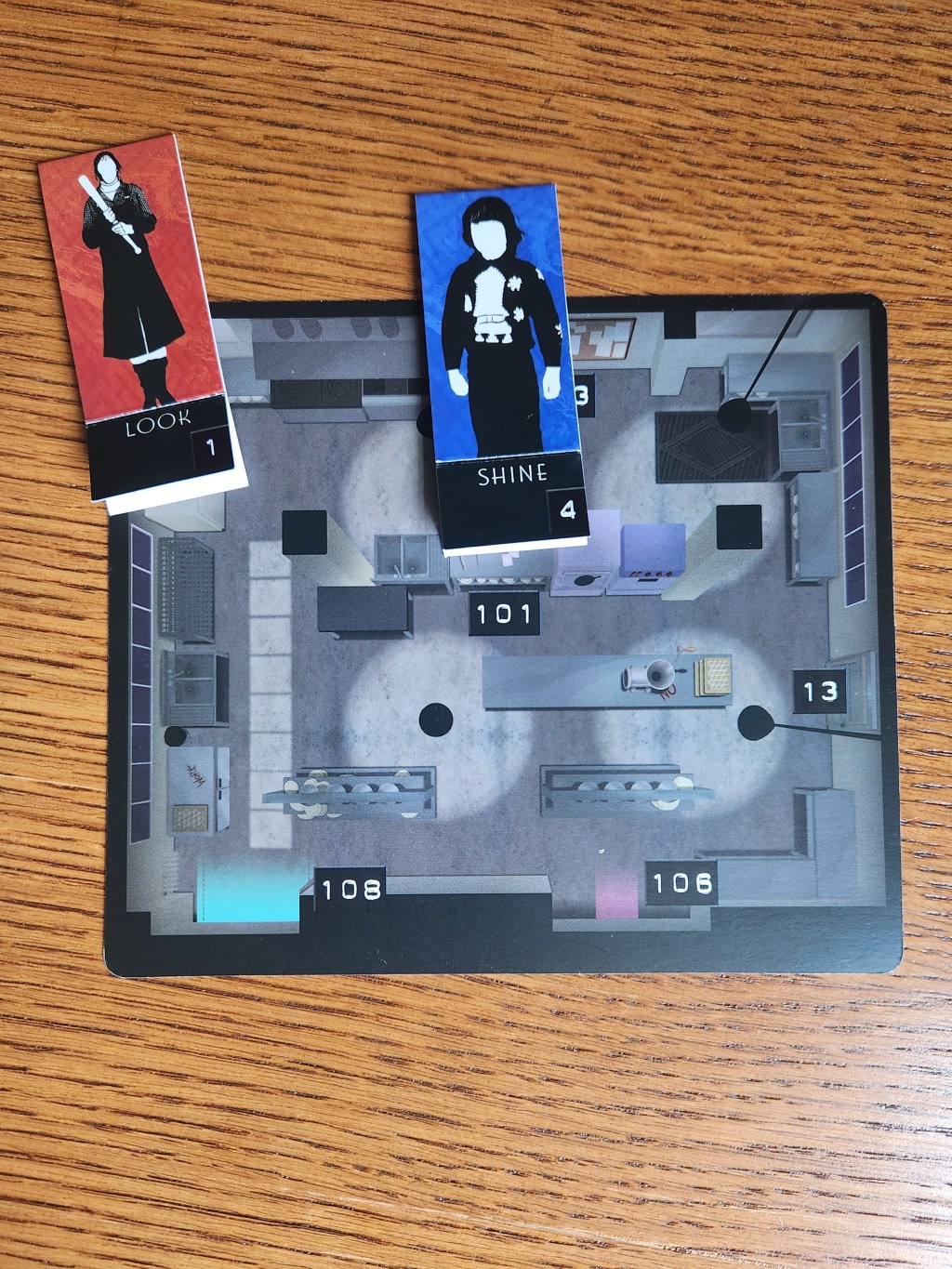
In the escape room-style Coded Chronicles game The Shining: Escape from the Overlook Hotel (2020), players build the navigable space as they go, revealing location cards and their attendant clues as they make choices and move around the hotel, a mechanic that echoes the tile system of Betrayal at House on the Hill and the Betrayal at the Neibolt House expansion. While Escape from the Overlook Hotel is a self-contained at-home version of the escape room dynamic, it includes key game elements of the experience, including interactions with tangible items and a reliance on teamwork. The game includes three journals (two written by Wendy and one by Danny), an Overlook Hotel Visitor Book, cards that reveal individual rooms of the hotel, and usable, manipulable items like decoders and a puzzle-map of the hedge maze. Each piece has different visual elements to explore and puzzles to solve by leveraging each playable character’s skills as rooms of the Overlook Hotel are revealed and explored, using “the ‘Coded Chronicles’ mechanism, which requires you to unlock clues and solve puzzles for unique storytelling codes” (“The Shining: Escape from the Overlook Hotel”). While Prospero Hall’s The Shining board game positions players as caretakers who have come to the hotel after the Torrances’ fateful winter, Escape from the Overlook Hotel is firmly grounded within the narrative of Kubrick’s The Shining, with players taking on the character identities and abilities of Wendy and Danny Torrance, as they attempt to survive Jack and the hotel.
Players begin in the Overlook Hotel’s kitchen by laying out the first of the large-scale room titles and begin engaging with this threatening and terrifying space from there. As reviewer Moe Tousignant notes, “The story starts in media res and really does a great job of ramping up the tension right from the start,” drawing players into the story as Wendy is attempting to lock Jack in the kitchen pantry. This opening moment is introduced through a long narrative description from a third-person point of view that privileges Wendy’s thought processes and emotions, as she fights off panic and struggles to figure out how she can protect herself and her son. This description aligns players with Wendy’s experience in a way that Kubrick’s film does not, inviting them into Wendy’s experience as Jack’s eyes open and “The pounding of her heart fills her ears. Having left the bat behind, she’s defenseless and she knows it.” Throughout Escape from the Overlook Hotel, players remain invested in Wendy and Danny’s perspectives, an active engagement that in some ways displaces Jack from the center of the narrative, offering a new experience of the familiar events of The Shining.
Players actively engage with the secrets the room holds, looking for more information and attempting to solve the puzzles that will allow them to progress to the next stage of the game, with the game creating “an immersive, real-time experience as [players] solve puzzles, unlock clues, and use in-game abilities to find a way out of the Overlook Hotel” (Buckley). Wendy and Danny have distinct skills and must combine their abilities in order to be successful: both Wendy and Danny are able to “Look” at the different parts of the room and potential clues, but each character also has a unique personal ability: Wendy can “Use” the items she finds, like a hammer, a knife, and various keys, while Danny can “Shine,” seeing beyond the physical reality of what actually is to what has already happened in the hotel’s past or what could happen in the future. Through these abilities, Wendy and Danny may gain different insights from or have different experiences with the same clue. For example, in the kitchen, when Wendy looks at the meat grinder she feels a vague sense of unease, though Danny is able to see more than meets the eye and his “stomach turns as he senses that this device may have been used to grind less savory types of meat in the past.” Clues and interactions like this build the sense of suspense and creeping dread as players actively and intimately engage with specific elements in each room, while others are strategically essential, like a closed door that Wendy is inexplicably unable to open, while Danny uses the shining and discovers Mr. Grady lurking on the other side. Players combine the characters’ abilities to Look, Use, and Shine to make their way through the Overlook Hotel, solving puzzles as they try to escape.
Much like Escape from the Overlook Hotel builds upon and deviates from Kubrick’s established narrative elements, the game also reimagines potential alternate endings. Gameplay is designed to guide players toward a successful conclusion in which Wendy and Danny survive and escape, but this is not a foregone conclusion, and the story can take some fatalistic turns along the way. The game refers to these outcomes as “Unscripted Endings,” with the rules reassuring players that “It is possible in this game for the story to end before it should have,” as the result of players’ incorrect or misguided choices. If you want to know some of these alternate endings, though, you’ll have to play and find out …


