
For the last several weeks, I have had the absolute privilege of participating in the Culver-Stockton College Theatre Department’s production of Carrie: The Musical, in the itty bitty role of prom chaperone who gets killed (along with everyone else) by Carrie. The process started about five weeks ago, with auditions and a read through, and culminated this past week with a high school preview performance and four sold out shows. I had the absolute time of my life (and death) working alongside these incredibly talented students.
(See program info with full list of these phenomenal faculty and students at the end of this post!)
I was aware of but hadn’t seen or heard Carrie: The Musical and when I learned that the theatre department would be doing the show, I intentionally avoided it so that I could discover the story as we worked through the process and our students’ version would be my definitive version. Carrie: The Musical takes some really interesting approaches to adapting Stephen King’s 1974 novel and I find myself considering familiar moments and characters from entirely new perspectives.
For example, in King’s novel, Carrie has the occasional outburst or refusal of her peers’ and mother’s abusive treatment, but she largely keeps her head down, remaining soft-spoken or silent. And while there’s still an element of that deferential behavior in the musical version, there are also solo songs like “Carrie” and “Why Not Me?” that provide insight to Carrie’s depth of feeling and vision of herself, including the possibility for change. Our Carrie was played by the tremendously talented Addison Wetzel and every single time she belted out these lyrics, Carrie’s pain, yearning, and heartbreaking hope reverberated in every note and word. I’ve probably read King’s novel more than a dozen times at this point and every time I read it, Carrie’s pain lands with just as much power, which is a testament to the effectiveness and timelessness of King’s work. What I didn’t anticipate when I started working with the students on Carrie: The Musical was that Carrie’s pain could actually hurt WORSE. Absorbing the emotion of Addison’s performance opened up a whole new level of empathetic engagement: I understood Carrie even more than ever before and her suffering broke my heart in new, even more painful ways that are impossible to shake.
Another performance that fundamentally changed my understanding of and engagement with King’s Carrie was Madison Pruitt as Margaret White. In King’s novel, Margaret is not an easy woman to understand and she’s pretty darn impossible to love. While I wouldn’t necessarily say that Margaret becomes a sympathetic character in Carrie: The Musical, she becomes a character the audience can know in a different way, with songs like “And Eve Was Weak” and “Evening Prayers” highlighting the complicated but truly loving relationship between Margaret and Carrie, while “When There’s No One” shows us the way Margaret contends with what she feels driven to do and her preemptive grief of losing Carrie. Every single Margaret scene resonates with the trauma she has endured and her driving need to protect her daughter at all costs. We can’t condone what she does, but in this iteration of her character, we can feel that emotional resonance, allowing us to understand how she’s feeling and why she does it. Just as Carrie’s pain and longing echo through the show, Margaret’s pain and fear are emotionally palpable, and Madison’s performance opened my eyes to a vulnerability in Margaret that I had never recognized over all these years and re-readings, and I’ll never be able to see Margaret the same way again.
The ensemble also added depth to previously ill-defined stock characters. In reading the book and getting occasional glimpses or mentions of character names, it is easy to see them as almost a backdrop to the real action, flat characters who are there but fall short of fully developed individuals. However, the talented ensemble of this performance—along with additional characters like Sue (Zoey Kiser), Tommy (Kai Maurice), Chris (Eireland Cady), and Billy (Riko Davis)—showcase the different individual experiences and internal realities each one faces, the pressure to fit in and the motivation that leads to the fateful events of prom night. Whether in a collective song like “In” or character-focused interactions like “Do Me a Favor,” the musical numbers and dialogue between characters reveal why these teens make the choices they do, the emotional experiences and deep needs that drive their actions. As Sue (Kiser) says early in the play with heartbreaking sorrow, “We were just kids!” As presented and embodied in Carrie: The Musical, they are not an anonymous, faceless mass of teenagers: they are individuals, each carrying their own pains and burdens.
Every single person involved in the production, both on stage and behind the scenes, put so much of themselves into this show, and our collective experience embodied the story of Carrie in a way that no book or film adaptation could ever come close to. I’m honestly still processing the experience and struggling to put into words just how much it has meant to me, how profoundly it has impacted me, and the new perspective it has given me on King’s novel. What I can say for certain, however, is that it was an absolute privilege to work with director David Lane, the cast, the crew, and everyone involved, and I am so incredibly grateful to have played my own small part in Carrie: The Musical.
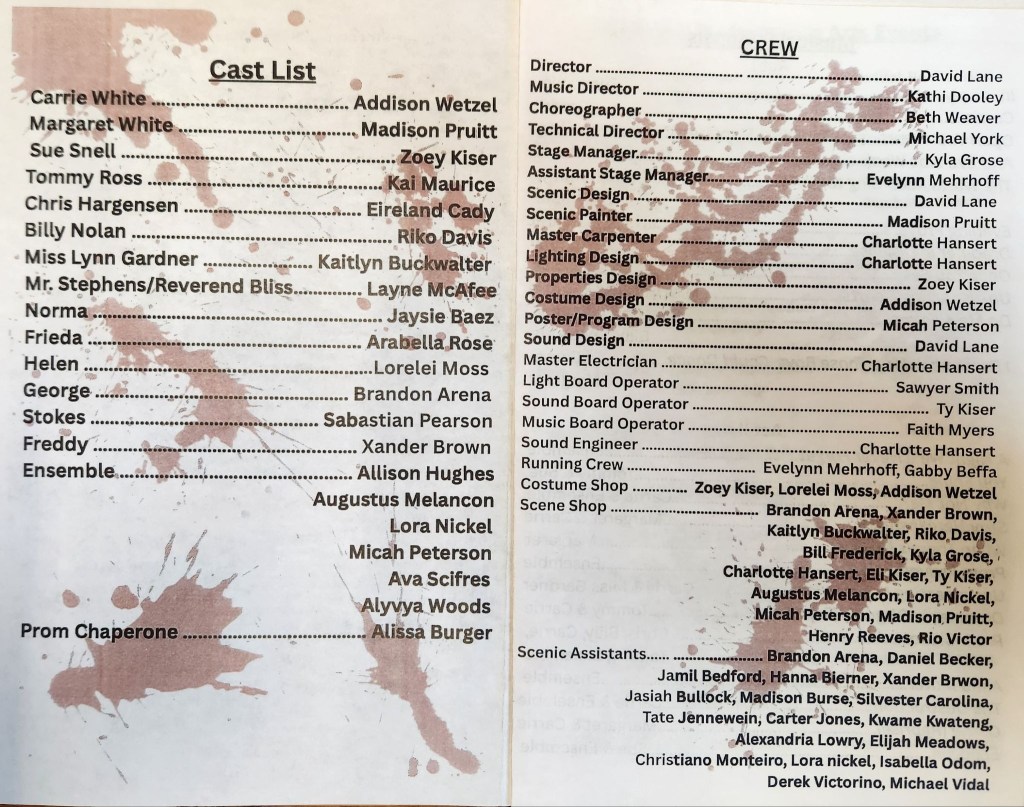
[Program design featured in main image designed by Micah Peterson]


