I finished up a draft of my film adaptations chapter over spring break a couple of weeks ago and am now turning my attention to board games based on Stephen King novels for the next chapter in the queue (and my last close reading / case study chapter!).
I’ve been doing a fair amount of work on board games and narrative immersion in recent years, including the late, great slasher-inspired Mixtape Massacre (2016; Director’s Cut 2022) and several board games that adapt or riff on Mary Shelley’s Frankenstein (1818), including Ravensburger’s Horrified (2019) and Plaid Hat’s Abomination: The Heir of Frankenstein (2019). All of these games foreground literary and cinematic geography in fascinating ways, giving players the opportunity to move through these worlds and become active participants in these stories as they unfold, often in ways that offer a fresh perspective on or disruption of the familiar story.
As I started digging into King-inspired board games, I was a bit surprised at how few there are … at least until I started thinking about what that might look like. A board game based on Pet Sematary (1983), for example, where you take on the role of Louis Creed and navigate the Gothic wilderness to bury and resurrect your loved ones, facing untold horrors along the way, would be unsettling for sure (but a hell of a lot of fun for fans of horror and King). Or a riff on the classic game of Operation with an Annie Wilkes-style twist? (Though that could get REAL dark REAL fast). On second thought, maybe it’s not so surprising that few of King’s novels have been adapted into playable formats.
There are two King novels that have been adapted into board game formats, though in both cases, the board games could be more accurately described as game adaptations of film adaptations of King, which raises some really interesting questions about the process of inspiration, adaptation, and how a story can look different and be experienced in a new way depending on the medium in which it is presented.
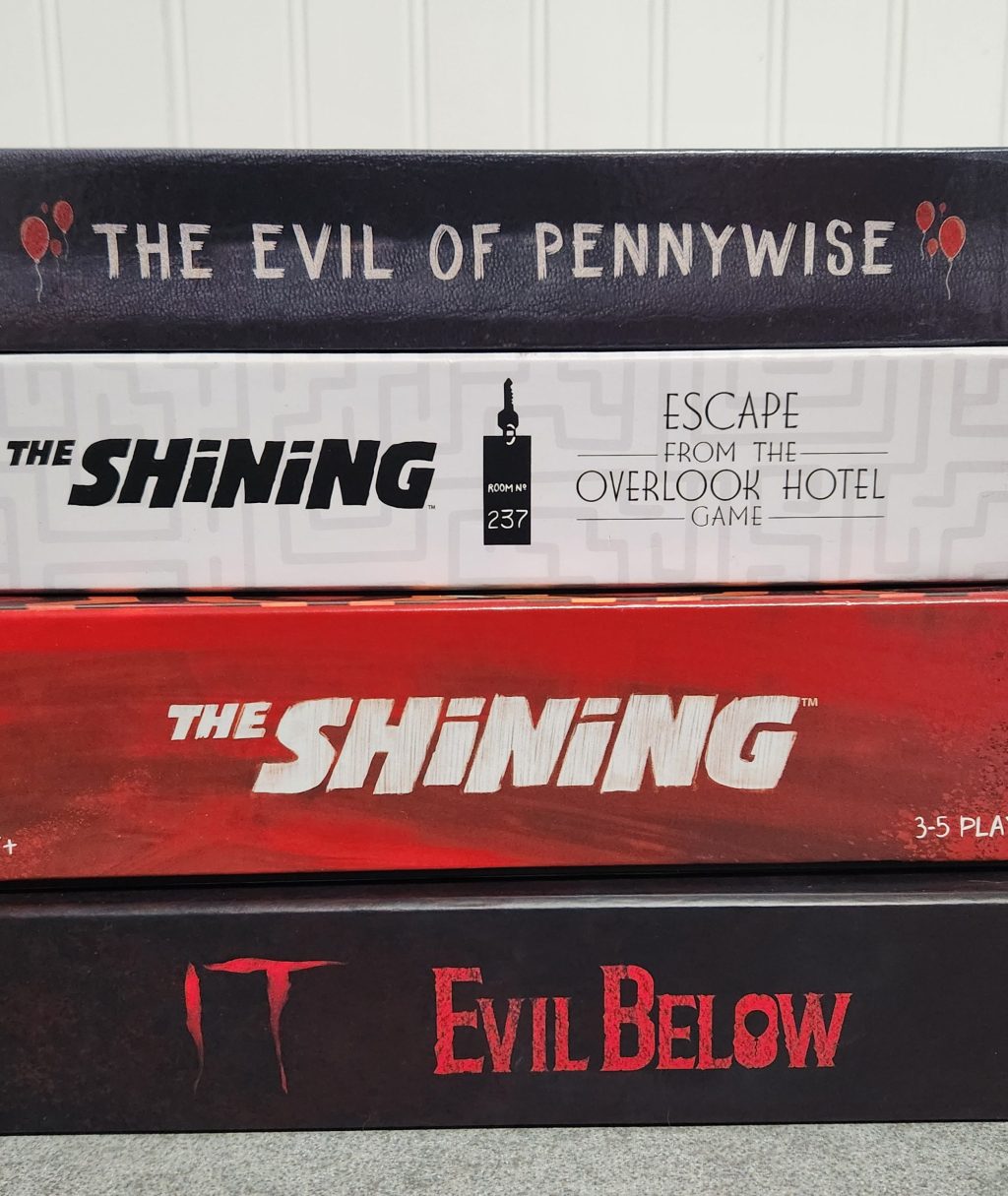
First, there are a couple of different board game adaptations of Andy Muschietti’s IT films. IT: Evil Below (2019) is inspired by Muschietti’s IT: Chapter One (2017), while Betrayal at the Niebolt House: The Evil of Pennywise (2025), is an expansion for Avalon Hill’s Betrayal at House on the Hill (2004) inspired by Muschietti’s IT: Chapter Two (2019). In both games, players navigate key spaces from the story, including the landmarks of Derry in Evil Below and the rooms of the House on Neibolt Street in Betrayal. Both are cooperative games, allowing the players who assume the roles of the different Losers Club members to work together to fight against Pennywise.
The other King work that has been adapted for multiple games is The Shining (1977), specifically Stanley Kubrick’s 1980 film adaptation, a negotiation and reading that is complicated by King’s infamously negative response to Kubrick’s film. Prospero Hall’s The Shining and the Coded Chronicles game The Shining: Escape from the Overlook Hotel (2020) both build on the iconic design and imagery of Kubrick’s film, including the unforgettable carpet pattern and hedge maze. Both games are collaborative, with players in the board game version of The Shining trying to outlast the influence of the hotel, even as it attempts to influence and control players, while the Coded Chronicles game requires players to solve riddles to progress to the next stage of game play.
IT: Evil Below and The Shining board game give players a clear view of the entire board from the start, offering the (misleading) reassurance that they can master the spaces they navigate, with key locations in Derry including Keene’s Pharmacy, the Standpipe, the Quality Meats Butcher Shop, the Town Square, Bev’s apartment, the House on Neibolt Street, and the Barrens, while central Overlook Hotel locations in The Shining featuring the office, the Colorado Room, Room 237, the kitchen, the caretaker’s apartment, and the Hedge Maze. In contrast, both Betrayal at the Neibolt House and Escape from the Overlook require players to actively engage with limited locations and spaces in order to reveal the next location, whether that’s a room in the Neibolt Street house or in the Overlook Hotel. These are two distinctly different ways of engaging with and navigating these fictional spaces and the narratives they hold, but each puts the players immersively within the locations within which these stories play out, with their choices shaping the narrative that unfolds in ways that are beyond the scope of fiction or film.

 Exploring Stephen King's Maine