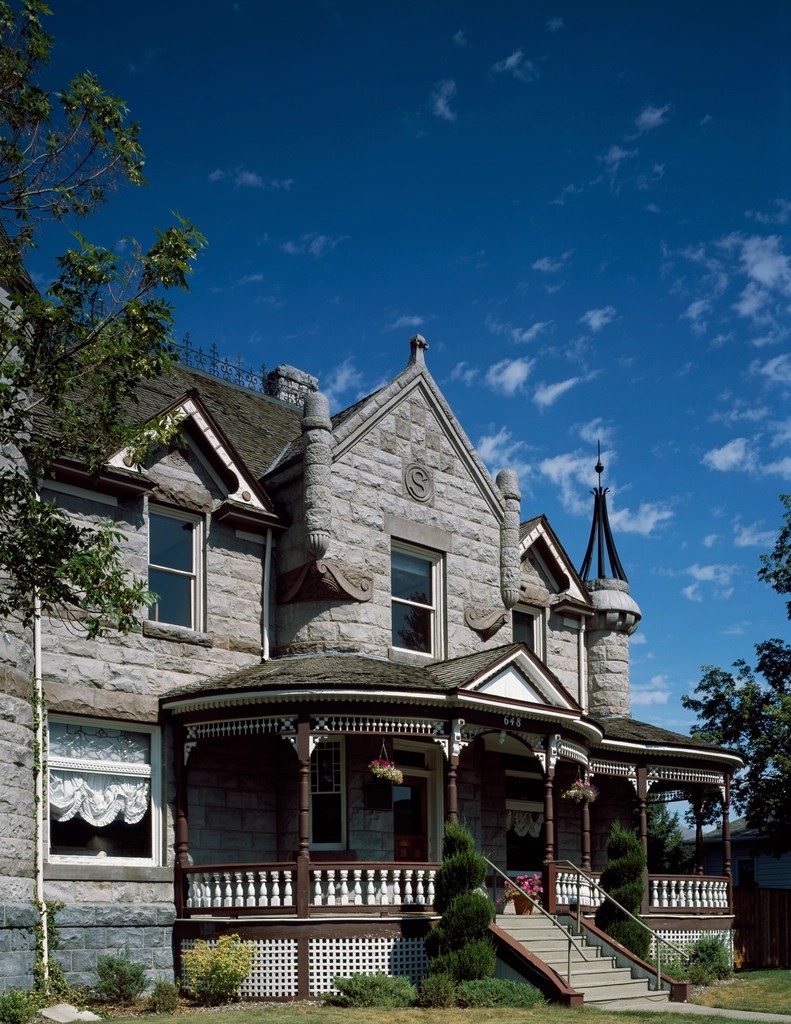
As I continued to think about the Marsten House, the architectural uncanny, and spatiality following last week’s exploration of artists’ representations of the house, I returned to King’s ’Salem’s Lot (1975) to reread the descriptions he provides of the house there, particularly Ben Mears’ recollections of his childhood visit to the house on a dare and Susan Norton and Mark Petrie’s ill-fated reconnaissance of the house, once they and their friends begin to suspect Barlow’s true nature and the threat he poses to Jerusalem’s Lot.
As Ben recalls his childhood horror, he tells Susan that “I crept up the stairs, a little kid, nine years old, scared shitless. The house was creaking and settling around me and I could hear things scuttling away from me on the other side of the plaster. I kept thinking I heard footsteps behind me” (41) as he made his way up the stairs to Hubie Marsten’s bedroom. When Susan and Mark enter the house years later, the same state of decay still holds, as they climb through the window into “a deserted, boxy parlor with a thick patina of dust on the floor … peeling wallpaper, two or three old easy chairs, a scarred table. There were cobwebs festooned in the room’s upper corners, near the ceiling” (300). Mark’s experience of the house in particular is almost a mirror image of Ben’s: after finding himself imprisoned in the same second-floor bedroom that haunts Ben’s nightmares, Mark escapes and bolts toward freedom as “he turned and fled down the stairs, leaping two or three at a time on his numb legs, his hand skimming the splintered bannister … The front hall was shadow-struck, horribly dark” (310).
While these descriptions provide a vivid and atmospheric sense of individual rooms—the stairs, the front hallway, Hubie Marsten’s bedroom upstairs—the layout of the house as a whole remains relatively undefined, making it easy for both characters and readers to become disoriented and lose themselves within the Marsten House, which amplifies the horror that lies within, in both its human and supernatural evils.
In considering these atmospheric engagements, I found myself pondering the ways that the past and the present are collapsed within the Marsten House, both in King’s novel and in the house’s appearance in the second season of the Hulu series Castle Rock (2018-2019). In King’s novel, after the discovery of Hubie and Birdie Marsten’s dead bodies, people from Jerusalem’s Lot enter the house, which is described as “a nine days’ wonder” (39). Nothing seems to have ever been thrown away and the past is absolutely, physically present in the “piled, jumbled, bewildering rat’s nest of junk, scavenged items, and narrow, winding passageways which led through mouldering white-elephant books” (39). In addition to the tangible remnants of the past, Hubie Marsten’s legacy carries on long after his death, with Marsten responsible for Barlow’s coming to the Lot. The version of the Marsten House in Castle Rock is similarly dilapidated at its first appearance, though Amity’s (Mathilde Dehaye) followers quickly transform it, including murals on the walls that depict the early days of Castle Rock’s settlement, emphasizing the malevolent return of these early settlers, as they literally record their presence—both then and now—on the walls of the house, emphasizing the pervasiveness of their influence and reclaiming of these spaces.
The Marsten House epitomizes William Faulkner’s famous quote that “The past is never dead. It’s not even past.” The history of the dark deeds committed at the Marsten House can never be laid to rest and under the right circumstances—such as an old correspondence bringing Barlow to Jerusalem’s Lot or the return of Amity and her followers—the past can overtake and even eclipse the present.
[Page numbers are from 1975 Doubleday edition of ’Salem’s Lot]

 Exploring Stephen King's Maine