One of King’s short stories that I really have a lot of fun teaching is “The Crate,” in part because (like with “N.”, which we discussed on our opening day of class), we’re able to engage with the narrative through so many different mediums. There’s the original short story, which was published in the 1981 collection The Arbor House Treasury of Horror and the Supernatural, then the two Creepshow (1982) versions, in both comic and film adaptation format.
There’s a lot to dig into in the story, particularly in terms of characterization, with the complicated relationship triangle between Dexter, Henry, and Wilma giving us the opportunity to look not just at individual characters, but the interconnected stressors and conflicts in their respective relationships as well (including some theories – or perhaps just wishful thinking – I have about Dexter and Henry’s “companionship” [591]). The complex narrative that jumps around in time to simultaneously reveal the horror, Dexter’s telling of it, and the way Henry leverages the mayhem to his own ends is another particularly interesting point of consideration that allows us to look at both the story and King’s craft. The story’s setting at Horlicks University also allows us to briefly consider the interconnectedness of King’s fictional universe, where Horlicks also appears in Christine (1983), From a Buick 8 (2002), and the story “The Raft” (included in the 1985 Skeleton Crew collection), which we read later in the class.
But one of the most exciting elements of our discussion of “The Crate” is what the creature actually looks like. We know the specs of the crate itself: “about five feet long and two-and-a-half wide … perhaps three feet deep” (575-6) and weighing a couple of hundred pounds (577). As Dexter and the janitor open the crate, we get some details about the creature’s behavior, including its “whistle … something like an ugly, hysterical shriek by a tantrumy child. And this suddenly dropped and thickened into a low, hoarse growling sound. It was not loud, but it had a primitive, savage sound that stood Dex Stanley’s hair upon the slant” (580). The creature is “incredibly strong” (581) and has a powerful bite, which is evidenced when it seizes and drags the janitor into the crate itself, as it “began to snarl and gobble” (581). It’s strength, violence, and appetite are clear, but the physical descriptors of the creature are fragmentary: it is “dry and brown and scaly as a desert reptile” (581). It has “huge claws” (581) and “two green gold eyes” (586). The clearest glimpse Dexter gets of the creature is when it attacks the graduate student Charlie Gereson and Dex sees “a furry, writhing shape spread-eagled on the young man’s chest, a shape that appeared to have not four but six legs and the flat bullet head of a young lynx” (586-7). Much like the parable of “The Blind Men and the Elephant,” we have isolated details, but little sense of the whole.
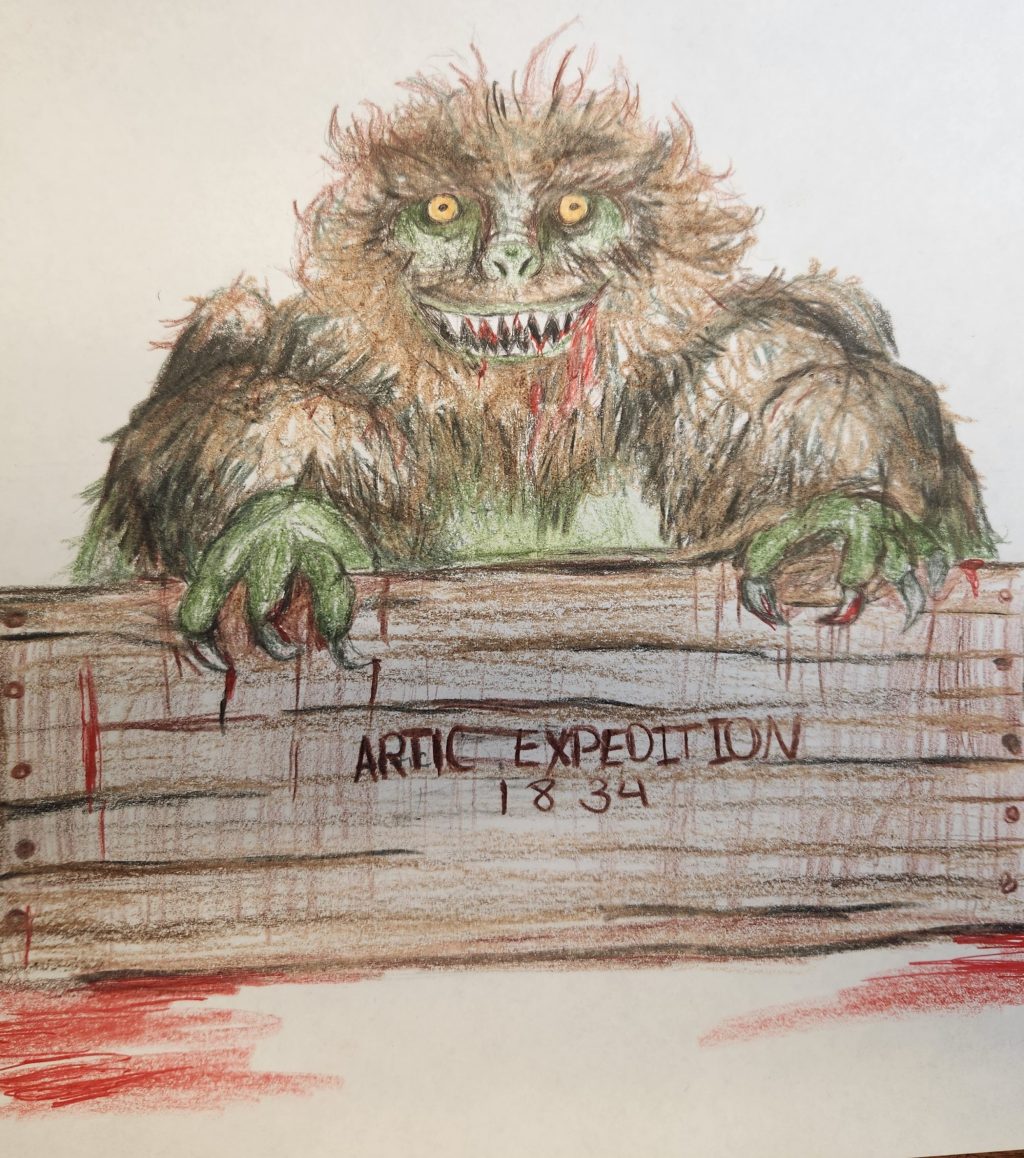
After we have discussed the story and focused our close reading attention on these details of what the creature looks like, I challenge students to create their own vision based on these isolated clues. We have different art supplies on hand and using King’s descriptions (which we have on the board for regular reference and artistic inspiration) as their guide, they each create their own creature. Students take a range of different approaches to their interpretation: some look to real animals for inspiration, like the lynx or the owl that serve as comparisons within the story for the shape of the creature’s head or the gleam of its eyes. Based on the sounds the creature makes, students have also looked to animals like the Tasmanian devil or the hyena for inspiration as well. Some draw on their familiarity with other monster types from films and television, while others take a more freestyle approach, producing the individual elements (i.e. the six legs, the long claws) and then finding a way to combine them into a cohesive whole. Some of them inevitably check out the Creepshow images and get a sneak peak of Romero’s “Fluffy” (though we don’t watch the film segment together until after we’ve developed our own imaginary creatures).
No two creatures have ever looked the same and we have a great time comparing and explaining why our individual creatures look the way they do, the specific descriptive details from the story that resonated with them as they worked, and the larger textual influences of their artistic design. This has become one of my favorite activities in the class, listening in as the students talk through their choices with one another as they work and then hearing their synthesis of process and product when they share their monstrous vision with me and their classmates.
I have started building a Crate Monster Hall of Fame in my office and the one featured here, by Gracie von Thun, is the latest addition to that monstrous menagerie!

 Exploring Stephen King's Maine