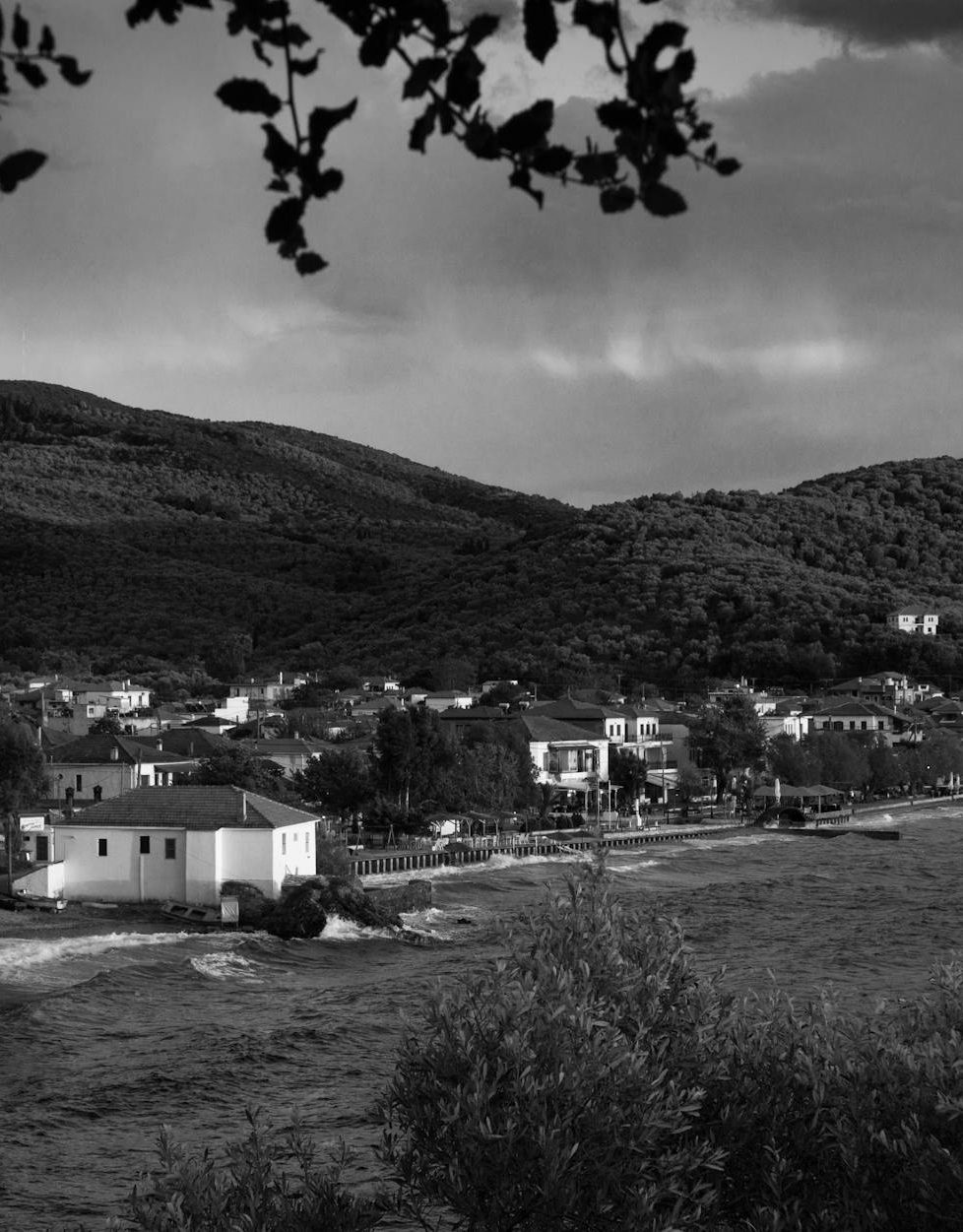
While Derry and Castle Rock are contemporary touchstones in King’s fiction, with a range of interconnected stories that cover the late 20th and early 21st centuries, Jerusalem’s Lot is a particularly fascinating example of literary geography in King’s work, with stories that have a much wider chronological reach, including “Jerusalem’s Lot” (in the 1978 collection Night Shift), ’Salem’s Lot (1975), and the ’Salem’s Lot sequel “One for the Road” (also in Night Shift), as well as the popular culture adaptations of Chapelwaite (2021) and Castle Rock (2018-2019). The threat of Jerusalem’s Lot morphs and shifts over the years and from story to story, but the sense of the town as a “bad place,” a geographic location where there’s something fundamentally not right steadfastly persists.
Each of these horrors—from Lovecraftian monsters to vampires and colonizing bugs capable of reanimating the dead—are all deeply rooted in this profound sense of place. In addition, each of these threats a clear focus on spreading the contagion of Jerusalem’s Lot to as many people as possible, creating a population of corrupted and monstrous citizens that shape the horrors and identities of this place they occupy, resistant to any lasting defeat.
In “Jerusalem’s Lot,” Charles Boone has inherited a home (Chapelwaite) in 1850 near Preacher’s Corners and Jerusalem’s Lot, Maine, though his first impressions of the house are not promising, as he writes his friend Bones “the house is quite as fine as I had been led to believe by my cousin’s executors, but rather more sinister” (1). “Jerusalem’s Lot,” H.P. Lovecraft’s “The Rats in the Walls” (from which King drew inspiration for his own story), and the Epix series Chapelwaite (which adapts King’s story as a ten-episode series) provide interesting points of intersection and negotiation for considering this place, the house, and the family’s legacy, both in the home itself and within the larger community.
Lovecraft’s Delapore and King’s Boone both go digging, finding more than they bargained for, particularly in the dark rituals embraced by previous generations of their families. Delapore descends beneath Exham Priority itself, with the horror firmly rooted in this domestic space. The history of violence is built into the very stones of the priory itself, with:
its peculiarly composite architecture; an architecture involving Gothic towers resting on a Saxon or Romanesque substructure, whose foundation in turn was of a still earlier order or blend of orders—Roman, and even Druidic or native Cymric, if legends speak truly. This foundation was a very singular thing, being merged on one side with the solid limestone of the precipice from whose brink the priory overlooked a desolate valley three miles west of the village of Anchester. (Lovecraft)
Just as the different architectural traditions bury those that came before them, Delapore’s family has attempted to erase their horrifying lineage and the sins of their ancestors, though Delapore’s experiences at the priory exhume these in pretty short order.
In “Jerusalem’s Lot,” Charles Boone finds himself in a similar situation, physically navigating the halls of Chapelwaite and attempting to become part of the local community (though he does this latter with little success). While the role of this specific geographic place is foundational to the horrors of Chapelwaite and the Boone family, in King’s story, Boone must venture forth from the house to find the dark truth. Boone and his companion Cal find the core horror of the Boone family heritage in a church in Jerusalem’s Lot, which “reared above us, grim, uninviting, cold. Its windows were black with the shadows inside, and any Godliness or sanctity had departed from it long ago. Of that I am certain” (12). The church is just the doorway to deeper horrors, however, as Boone discovers a book on the pulpit titled De Vermis Mysteriis, which eventually unleashes a Lovecraftian horror from below the very church itself, accompanied by undead remnants of Boone’s own ancestral line.
In a dynamic act reframing this geographic place and its power to once again inter its dark secrets, the veracity of these horrors is contested within the stories themselves. Delapore is institutionalized at the end of the story after further subterranean horrors are discovered, claiming that “I did not do it. They must know it was the rats; the slithering scurrying rats whose scampering will never let me sleep; the daemon rats that race behind the padding in this room and beckon me down to greater horrors than I have ever known; the rats they can never hear; the rats, the rats in the walls.” Similarly, when Cal is killed in his and Boone’s encounter with the monstrosity beneath the church in Jerusalem’s Lot, suspicion must inevitably fall on Boone, though the prevailing assumption seems to be that Boone has had a relapse of the brain fever from which he had recently recovered before coming to Chapelwaite. By retelling these stories in ways that replace supernatural horrors with human ones, the local understanding of Jerusalem’s Lot can be (to some extent, at least) contained: certainly not eradicated, but resituated with something the people can live alongside, however uncomfortably.
Given that Jerusalem’s Lot is clearly marked as a cursed place prior to 1850, when Boone arrives and discovers its horrors, it is perhaps a bit surprising that it is such a settled and prosperous small town when we see it next in ’Salem’s Lot. Evil remains, though it has taken on a more insidious form, this time through the operation of vampires who for the most part do their work in the shadows and behind drawn curtains. There is still, however, a strong connection between monstrous horror and human horrors, including scenes of child abuse, violent assault, and exploitative business dealings. The evil is also explicitly addressed as being self-perpetuating, once again inseparable from Jerusalem’s Lot itself. Hubie Marsten, an infamous and depraved resident from a generation back, casts a long shadow over Jerusalem’s Lot and is arguably a kind of town boogeyman, particularly in the notoriety of the reputedly haunted Marsten House. While Marsten is now dead, he is the one who invited the vampire Straker to the Lot, with one evil man calling to another, keeping the cycle of violence and corruption going in Jerusalem’s Lot.
(Interestingly, through the name “Jerusalem’s Lot” has a long, established history, as demonstrated by the events of “Jerusalem’s Lot,” current residents have developed their own local legend and history about the provenance and significance of the town’s name, to do with a wild, cranky pig and the warding off of trespassing children).
Ben Mears, Mark Petrie, and the larger (though ill-fated) intrepid vampire-hunting team do their best to stake the vampires of the Lot and when that proves ineffective, Ben and Mark return to set the town on fire, though the evil persists. There are a range of local superstitions in the surrounding area about Jerusalem’s Lot and in “One for the Road,” Booth says “Sometimes, late at night, when there were just a few regulars drawn up around Tookey’s fire, people would talk it over. Talk around it is more like the truth” (311). Local residents don’t know who set the fire, though Booth tells readers “It burned out of control for three days. After that, for a time, things were better. And then they started again” (311). Booth, Tookey, and Gerald Lumley venture into the Lot in a blizzard in an attempt to rescue Lumley’s wife and child and while they find them, they’re too late to save them and not strong enough to defeat them. Booth and Tookey survive, retreat, and are haunted by these encounters, well aware that there is always that danger lurking just down the road.
Finally, in the Hulu series Castle Rock, the location of Jerusalem’s Lot is shifted to position it adjacent to Castle Rock, with the horrors of these two places overlapping and bleeding together. Here again, the past and present horrors of Jerusalem’s Lot are inextricable from one another, with Amity (Mathilde Dehaye), a self-proclaimed prophetess in the early 1600s, who killed followers and foes alike, setting the stage for a widespread resurrection of their spirits in contemporary 21st century citizens as they prepare to celebrate the 400th anniversary of Jerusalem’s Lot, proving that the more things change, the more they stay the same.
The horrors of Jerusalem’s Lot may change or adapt or disguise themselves to more insidiously exert their influence on unsuspecting people who are drawn to this particular patch of ground north of Portland, Maine. But one thing is certain: they aren’t going anywhere. From Amity’s sinister religious influence in the early 1600s to Lovecraftian horrors in 1850 and vampires in the 1970s, Jerusalem’s Lot has proven to be fertile ground for a range of terrors, which have become part of the very land itself.
[Page numbers from “Jerusalem’s Lot” and “One For the Road” are from the first edition hardcover of Night Shift. Quotes from H.P. Lovecraft’s “The Rats in the Walls” are from https://www.hplovecraft.com/writings/texts/fiction/rw.aspx]

 Exploring Stephen King's Maine