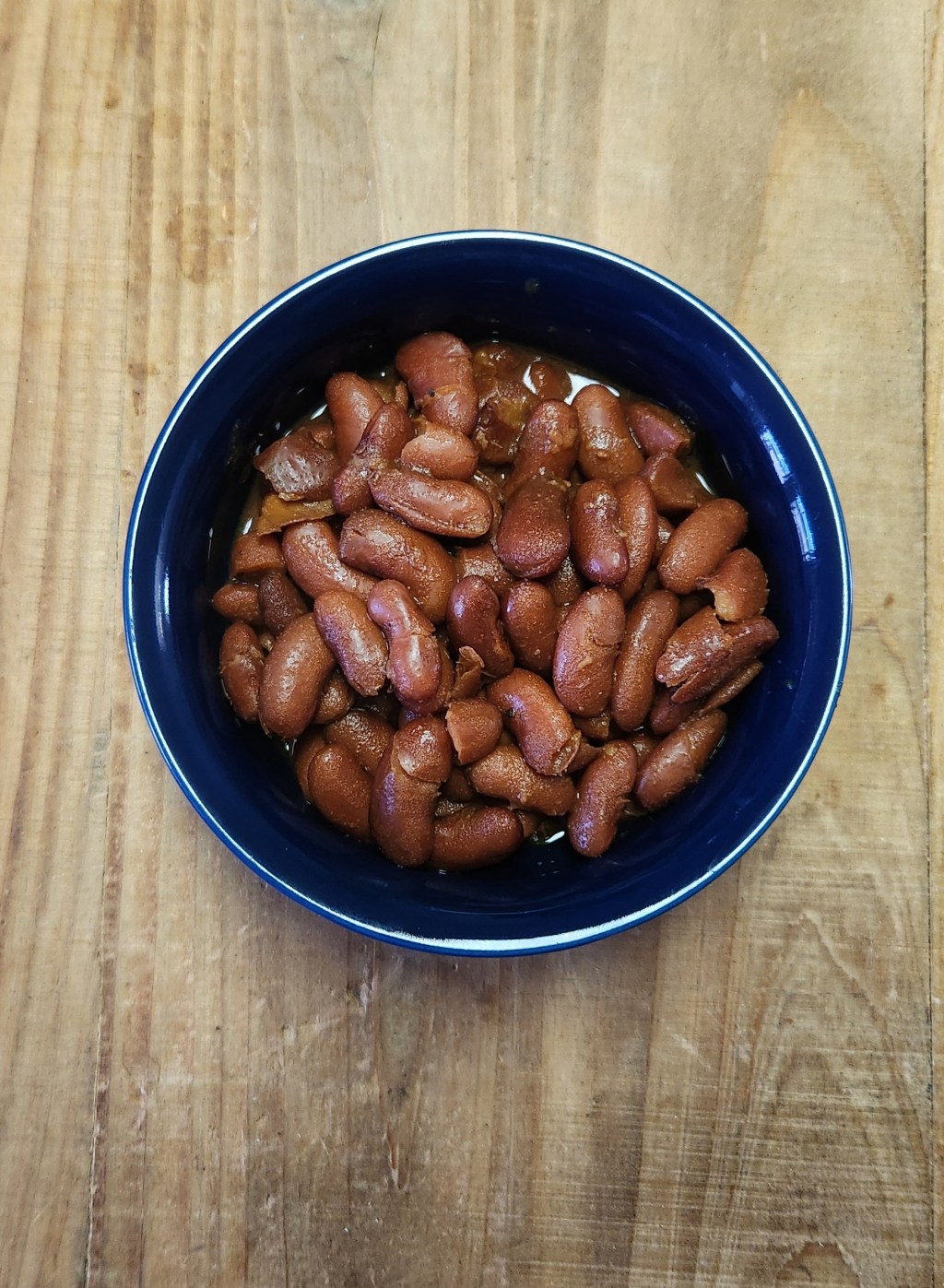
For our final road trip post on The Shining (1977), let’s take a moment to consider food, both through King’s descriptions in the novel and Carle-Sanders’ take on “Dick Hallorann’s Baked Beans” in Castle Rock Kitchen.
While there aren’t a ton of memorable food descriptions in The Shining—lots of soup and sandwiches and a heck of a Thanksgiving turkey are among the highlights—the comfort factor of food and the fear of food insecurity casts a long shadow, especially for Wendy, who finds her thoughts repeatedly returning to the Donner Party and the threat of cannibalism in the opening sections of the novel as she reconciles herself to the idea of her family spending the long winter at the Overlook Hotel.
Dick Hallorann’s closing day tour of the Overlook’s kitchen for the Torrances puts Wendy’s mind at ease to some degree. His inventory of the food they have on hand is meticulous and overwhelming, with “food in such amounts as Wendy had never seen before” (107). In the cold pantry, for example, there are:
A hundred boxes of dried milk (Hallorann advised her gravely to buy fresh milk for the boy in Sidewinder as long as it was feasible), five twelve-pound bags of sugar, a gallon jug of blackstrap molasses, cereals, glass jugs of rice, macaroni, spaghetti … a bushel of apples that scented the whole room with autumn; dried raisins, prunes, and apricots (“You got to be regular if you want to be happy,” Hallorann said, and pealed laughter at the cold-pantry ceiling where one old-fashioned light globe hung down on an iron chain); a deep bin filled with potatoes; and smaller caches of tomatoes, onions, turnips, squashes, and cabbages. (110-111)
The food itself is important, of course (they won’t be able to pop out on a quick trip to the grocery once the snow flies), but there are layers of meaning reflected in this list, including the sensory experience of and connection with food in the autumn-scented air of the cold pantry and the empathy and duty of care Hallorann expresses through his warm demeanor, his friendly advice, and this well-stocked larder which also includes “a twenty-pound turkey wrapped in a wide scarlet ribbon with a bow on top” (110). The refrigerators, freezers, and cabinets are all equally full to bursting with lots of good food to see the Torrances through the tough winter to come.
They are well provided for and yet, “the Donner Party kept recurring to her, not with thoughts of cannibalism (with all this food it would be a long time before they were reduced to such poor rations as each other), but with the reinforced idea that this was indeed a serious business” (107). Descriptions of specific meals may be few and far between, but the kitchen, its stores, and the pantry are never far from the Torrances’ minds, though this space takes on a darker turn when Wendy has to lock Jack in the pantry after he attacks her.
One meal that I took particular notice of on this food-focused reread is the cheese omelet and tomato soup that Wendy makes for herself and Danny as Jack is starting to become claimed by the madness of the Overlook. She makes her way carefully down to the kitchen with a knife in hand (another violent subversion of those domestic kitchen comforts), peering fearfully around every corner and over the top of the hotel’s front desk. King describes Wendy’s preparation of this simple lunch in detail, as Wendy gathers the ingredients she needs from the refrigerator and the pantry and this familiar routine soothes and comforts her. The kitchen itself is a reassuring space and Wendy “felt as if it was one of Danny’s safe places. Dick Hallorann’s presence seemed to enfold and comfort her” (557). She finishes making her and Danny’s lunch, gets it all on a tray, and prepares to head back up to their apartment. It’s only when she sets this tray on the front desk and goes to check on Jack in the Colorado Lounge that things go wrong.
This particular combination—a cheese omelet and tomato soup—was a new one for me. Grilled cheese and tomato soup is a go-to in my own culinary experience, but a cheese omelet strikes a different tone and I found myself curious. I followed Wendy’s steps closely, including grating the cheese and making the soup with milk (rather than water) to try this meal for myself. It’s definitely hearty and homey, but a completely different textural experience from grilled cheese and tomato soup, with the soft fluffiness of the omelet instead of the crispy, oozy goodness of a grilled cheese sandwich. I ended up putting a lot of crackers in my tomato soup to break up the soft textual monotony.
Given Dick Hallorann’s central position in representations of food in The Shining, it is unsurprising that Carle-Sanders’ Shining-inspired Castle Rock Kitchen recipe draws inspiration from this heroic chef. She goes with a post-Overlook recipe, developing her take on “Dick Hallorann’s Baked Beans” from Red Arrow Lodge in Western Maine, where Wendy and Danny come to stay the summer after their nightmare at the Overlook. The novel’s epilogue begins with Dick “checking over the salads his understudy had made and peek[ing] in on the home-baked beans they were using as appetizers this week” (675). Carle-Sanders’ recipe for these beans is included in the vegetarian section of the cookbook, with Mama Garraty’s commentary noting that she omitted the pork from Hallorann’s recipe.
There are good layers of rich and savory flavors in the sauce for these beans, including onion, molasses, and maple syrup, cooked at a low temperature for three to four hours. If I were to make these beans again, I would actually cook the beans even lower and slower, simmering them for several hours, either on the stovetop or in a slow cooker, to deepen the nuances of those flavors even more.
Despite the changes I would make the second time around with this recipe, I love that Carle-Sanders chose to develop a recipe from the characters’ lives post-Overlook, offering a taste of hope and highlighting the road forward, though that future won’t be an easy one, both in the trauma they now carry and new challenges to come.
[Page numbers are from 2001 Pocket Books paperback edition of The Shining]

 Exploring Stephen King's Maine