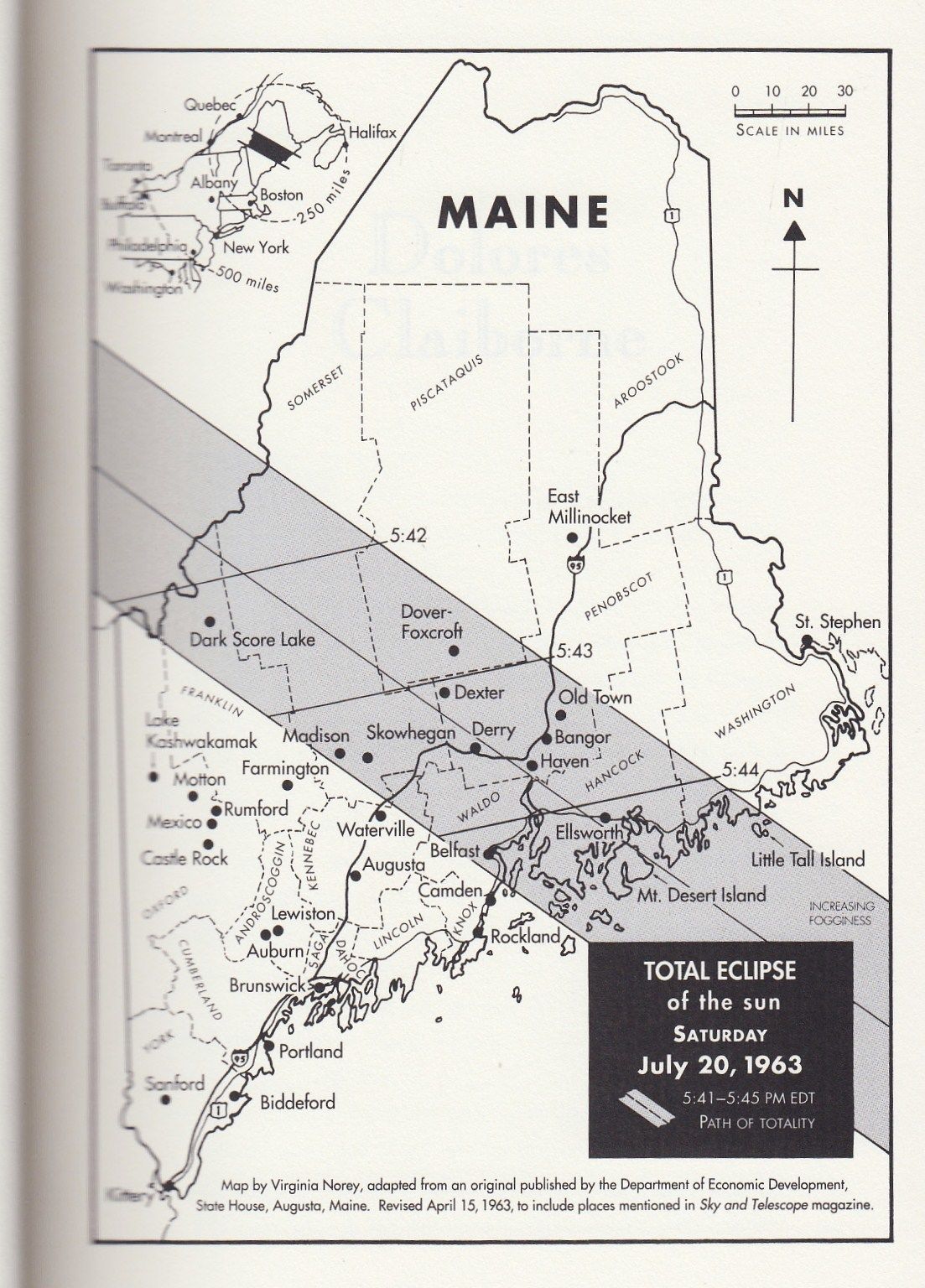
One of the most detailed maps of King’s universe in the novels themselves is the one that shows the darkness of the total eclipse central to both Gerald’s Game (1992) and Dolores Claiborne (1993), featured in the front matter pages of both novels. This map shows a detailed map of Maine, with some of King’s fictional towns situated within the existing landscape of real places, including Castle Rock, Derry, Haven, Dark Score Lake, and Little Tall Island. The map features traditional cartographic elements, including a scale and compass bearings in the upper-right corner and smaller map in the upper-left corner that situates the eclipse within the landscape of the New England and the East coast. A shaded area cuts across on a downward trending diagonal from left to right, mapping the path of the eclipse.
While King often provides narrative geographical clues to the location of his fictional towns by mentioning the real towns just down the road or other geographical features, like lakes and rivers, this map spatially pinpoints those places, making it a valuable resource for reading and engaging with a place-based reading of much of King’s writing. This map acts as a palimpsest, with King’s fictional and imaginary places laid over top of those that exist in the physical world, with the presentation of real and fictional side by side blurring the lines between the two, welcoming readers into a liminal space where both are “true.”
In reading Dolores Claiborne and Gerald’s Game, the mapped path of the eclipse is of central importance, symbolizing the trauma at the heart of both novels, as well as the secrecy and silence that conceal it. Both Dolores Claiborne’s Selena and Gerald’s Game’s Jessie suffer sexual abuse at the hands of their fathers, Selena prior to the eclipse and Jessie during the event itself. Both girls descend into an isolated silence following this abuse, afraid that they will be blamed for what happened to them, especially by their mothers, a fear that their abusers feed and exploit. With no one to reach out to for support and no words to articulate what has happened to them, Selena and Jessie are left alone in their own darkness. Repression serves as a darkness all its own as well, with Jessie’s mind blocking out her father’s abuse until she is fighting for her life in the cabin by Dark Score Lake in Gerald’s Game. While readers are unsure what Selena remembers in King’s Dolores Claiborne, Taylor Hackford’s 1995 film adaptation features a similar repression and remembering.
While the darkness of this sexual abuse is horrific on its own, there is also a kind of radiating darkness that spreads in the aftermath of each girl’s trauma, through Dolores’s murder of her husband Joe St. George during the eclipse and the further abuse that Jessie suffers as an adult at the hands of her husband Gerald. While the connection here is flip-flopped—Dolores commits murder during the eclipse because of what Joe did to Selena, while Jessie must face her repressed memories of abuse during the eclipse years later—the relationship between the abuse of these girls and later violence reminds readers that the darkness doesn’t really go away even when the eclipse has ended.
King features moments of connection between Dolores and Jessie, overtly tying these two narratives together. As the eclipse begins, Dolores has a vision of Jessie, far away across the state, “a little girl, maybe ten years old, with her own reflector-box in her hands. She was wearin a short dress with red n yellow stripes—a kind of sundress with straps instead of sleeves, you know—and lipstick the color of peppermint candy … I saw somethin else, as well, somethin that made me think of Joe: her daddy’s hand was on her leg, way up high. Higher’n it ought to’ve been, maybe” (232). Dolores and Jessie have this powerful mental connection again later, as Dolores kneels to yank off her torn slip after Joe falls into the well and Jessie kneels on her bedroom floor to search beneath her bed for a change of clothes after her father has ejaculated on her sundress. Jessie and Dolores are bound together by their physical position and by a powerful smell, “like pennies and oysters” (251) that comes from the well on Little Tall Island and from Jessie’s father on Dark Score Lake. They are both “in the path of the eclipse” (251) and for that brief moment, they see one another and find themselves not completely alone in the trauma they are enduring. Tied together in the worst moment of their lives, they remain connected over the years, however tangentially, and years later when Jessie is handcuffed to the bed in an isolated cabin, Dolores knows that “she’s in terrible trouble” (315). Dolores’ and Jessie’s suffering is not the same and there are many things that separate them, including the miles and gulf of years between them, but they both know what it’s like to be terrorized and abused, and they both find out what they’re capable of doing to survive and to protect the people they love.
In this pair of novels, King provides readers with two perspectives on abuse, through Jessie’s subjective experience and Dolores’s sense of powerlessness and rage when she finds out about Joe’s abuse of Selena. While Dolores protects her daughter, there is no one to protect Jessie, which makes this connection between Dolores and Jessie particularly significant: there’s nothing Dolores can do to stop Jessie’s father from abusing her, but however elusive and inexplicable it may be, Jessie has the slight comfort of knowing that someone was with her in the aftermath of this trauma, that someone sees and knows what has happened to her, even if she herself will refuse to see, speak of, or remember it in years to come.
While the darkness of the eclipse has concealed a range of sins, both Jessie and Dolores carry that darkness with them in their minds and in their hearts, long after the sun has reemerged.
[Page numbers are from Signet paperback edition of Dolores Claiborne]

 Exploring Stephen King's Maine