It has been a cold, snowy couple of weeks here, which got me thinking about Stephen King’s tales of wintery horror. There’s The Shining (1977), of course, but King has also written a couple of stories set on islands off the coast of Maine in the winter, including the excellent short story “The Reach” (published as “Do the Dead Sing?” in 1981; retitled and included in the 1985 Skeleton Crew collection) and his original screenplay Storm of the Century (1999) for a three-part ABC miniseries event.
In considering these islands—Goat Island in “The Reach” and Little Tall Island in Storm of the Century—they have some distinctive characteristics. (King’s 1992 novel Dolores Claiborne and 1989 short story “Home Delivery” are also set on Little Tall). The islands are separated from the mainland, an independence that is reflected in the grit, self-sufficiency, and solidarity of the people who live there. The only way on and off the island is by boat or ferry service, and when bad weather kicks up, those often aren’t viable options, leaving the islanders isolated and without any chance of escape or seeking help, should they need it. But the majority of the time, what happens on the island stays on the island, and the residents come together to take care of their business and of one another. As Mike Anderson says early in Storm of the Century, “Folks from Little Tall send their taxes to Augusta, same as other folks, and we got either a lobster or a loon on our license plates, same as other folks … But we ain’t the same. Life out on the islands is different. We pull together when we have to … And we can keep a secret when we have to” (10-11). Unlike many of King’s small Maine towns—Derry, Castle Rock, Jerusalem’s Lot—the islands are self-contained, with clearly demarcated and mostly impermeable borders. They are a land unto themselves.
The isolation is particularly pronounced in Storm of the Century, when two storm fronts collide to create a blizzard that combines cold, snow, and storm surge waves that take out the town dock and the lighthouse. Most of the islanders hunker down together in the town hall, both for safety and the comfort and solidarity of their friends and neighbors. But there are plenty of non-weather-related horrors going on on Little Tall in the midst of this storm. Just as the first flakes began to fall, a stranger named Andre Linoge knocked on old Martha Clarendon’s door and murdered her. There is a small contingent of men taking turns keeping watch over him in the town’s one jail cell in the back of Mike Anderson’s grocery store, and islanders keep turning up dead, along with the repeated imprecation to “give me what I want and I’ll go away” near their bodies. What it turns out Linoge wants is one of the islanders’ children, which instigates a heated debate between the islanders about the individual versus the collective good, as well as what they are willing to sacrifice for the safety and survival of the island.
I’ve been spending a good deal of time with Carle-Sanders’ Castle Rock Kitchen in recent weeks and in considering Storm of the Century, decided to try my hand at creating a King-inspired recipe again. With so many of the islanders taking shelter in the town hall, the older women of the island are focused on making food that can feed a crowd, like big pots of soup. This soup and the act of caring for their fellow islands demarcates some of the tensions and gender roles between people during the storm, as Ursula Godsoe chides town manager Robbie Beals, telling him about a photograph she has from the Storm of 1927, in which “I can point out your grandad … He looks like he’s stirring a pot of soup. Nice to know there was at least one fellow in your family knew how to pitch in” (119). Robbie’s son runs off from helping the other kids pick up toys, saying “I’m not gonna pick up! My dad’ll give me a doughnut!” (253, emphasis original). And Cat Withers and her boyfriend Billy Soames have a tense and deadly conversation against a backdrop of McCall’s Brand Grade A Fancy Apple Juice.
The recipe I decided to try out, however, was a cookie recipe to go along with Martha Clarendon’s last cup of tea. Martha is sitting down with her cup of tea and some cookies, watching the weather report forecasting the coming storm, when Linoge comes knocking on her door. After he has killed Martha, Linoge sits down in Martha’s chair, singing “I’m a Little Teapot” as he “grasps her teacup with a gory hand that smears the handle. Drinks. Then takes a cookie with his bloody hand and gobbles it down” (14). Later when they are gathered at the town hall, the children of Little Tall sing “I’m a Little Teapot” as they fall into a kind of trance state, coming under Linoge’s control as he prepares to present his ultimatum, with the repetition of this song bringing Martha’s tea and cookies once more to mind.
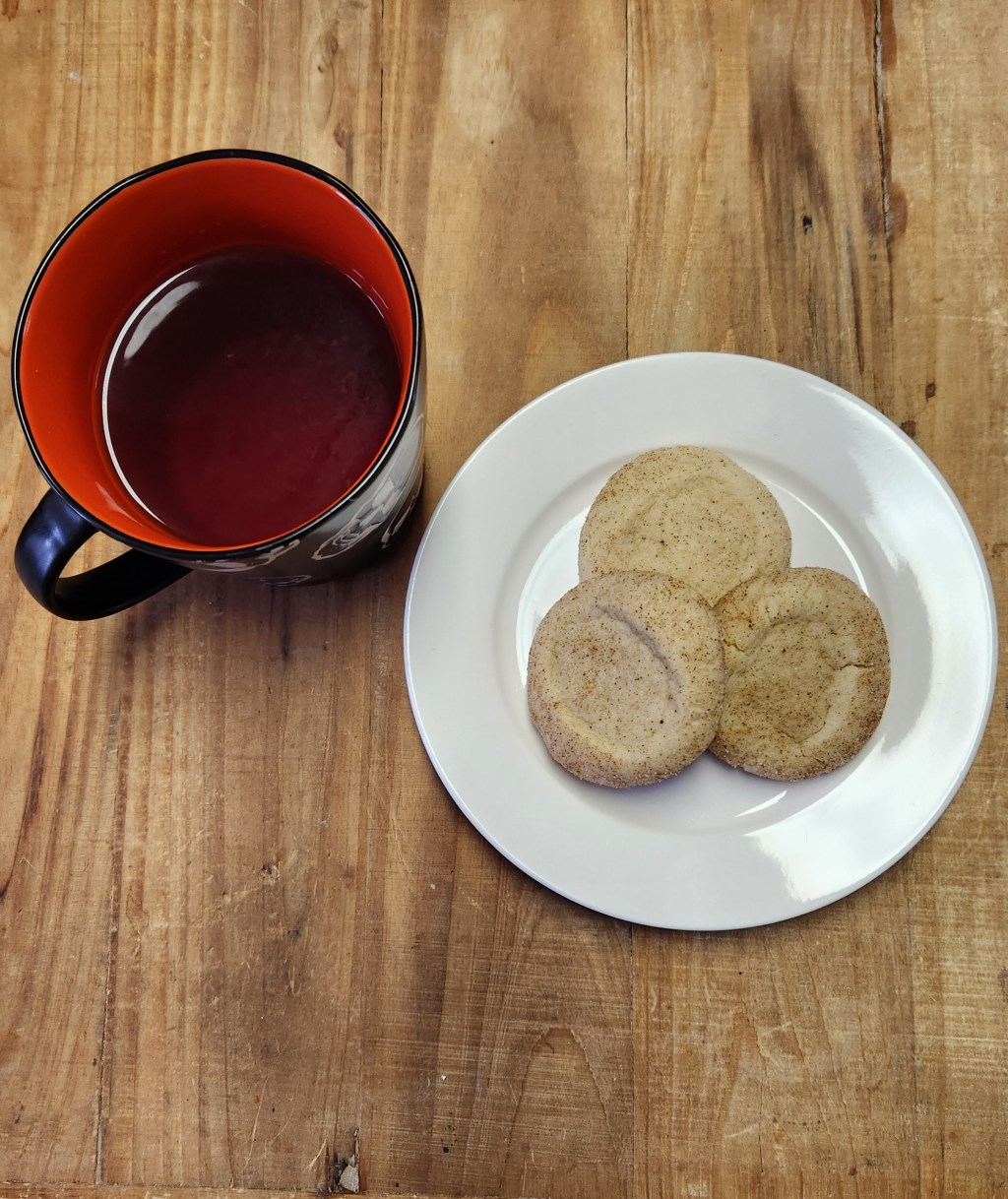
I spent some time thinking about what kind of cookies might be just right for Martha. Obviously not store-bought: she’s a proper lady who likes everything just so, based on the state of her home and the brief moments we see of her. She’s worried about the storm but not especially frightened—her repeated response to the weatherperson’s predictions is a restrained “Oh, dear” (9)—and would no doubt have stocked up on groceries, like her fellow islanders. Chocolate didn’t seem like a particularly complementary flavor to Martha’s tea as I was mentally shuffling through ingredients. What I decided on was a riff on a traditional snickerdoodle cookie, with chai-inspired spices rather than the usual cinnamon and sugar mix for rolling. It sounded like it would be good with a nice, hot cup of tea and the warm spices would be a comfort against the cold winds outside.
I started with a traditional snickerdoodle recipe from Modern Honey. There are lots of great snickerdoodle recipes out there, but I chose this one as a base for my own cookies because these ones were thinner than some of their stouter, cakier counterparts, which I hoped would result in a delightful combination of crispy edges and a chewy inside. I then did some more searching to look at a wide variety of different chai-inspired spice blends, where I found a quite diverse range of both spices included and the recommended amount of each. In the end, I made my chai-inspired coating with 6 tablespoons of sugar, ¾ teaspoon of cinnamon, ½ teaspoon of ginger, ¼ teaspoon of allspice, ¼ teaspoon of nutmeg, ¼ teaspoon of cardamom, and ¼ teaspoon of cloves. I rolled the snickerdoodle dough in this mixture and baked them at 350 degrees for 11 to 12 minutes to get a little extra crisp on the edges of the cookies. The cookies turned out great, with the desired balance of crispy and chewy, and I was really pleased with the flavor of the chai-inspired sugar coating.
These cookies were indeed delicious with a cup of tea and were a warm, spiced treat as I looked out at the cold, snowy day, thankful we just had a regular old snowstorm and not the Storm the Century.

 Exploring Stephen King's Maine