In IT (1986), Ben Hanscom was a fat kid. His size made him a frequent target of bullies like Henry Bowers and influenced a number of his day-to-day choices, like self-consciously wearing sweatshirts on even the hottest summer days. Much like Eddie’s mom smothered her son with her constant worrying and reminders of Eddie’s frailty, Ben’s mom asserted her control over her child and worked hard to keep the dangers of the wider world at bay through constantly feeding him. Big dinners, leftovers, snacks, and sweets—regardless of the food group, Ben’s mom made sure she had plenty of it, providing what she could, particularly when so many other things in the world and their lives were uncertain.
Looking back on his childhood with the hindsight of an adult, Ben tells his friends:
“It was a … a kind of security thing with her, I think. It was scary for her, trying to raise a boy on her own. She had no education and no real skills, just a willingness to work hard. And when she could give me a second helping … or when she could look across the table at me and see that I was looking solid …”
“She felt like she was winning the battle,” Mike said.
“Uh-huh.” (502)
When Ben returns to Derry to reunite with his fellow Losers, he is no longer that fat kid, but an incredibly successful, now “lanky” (72) man. And in the intervening years, his relationship with and feelings about food have changed considerably, in part because of an incredibly traumatic experience where he was bullied not just by his peers at his new school after he and his mother moved away from Derry, but by a coach who witnessed this abuse and heaped on a load of his own as well. After the coach tells the other boys to leave, “what he did was grab one of my tits in each hand and squeeze. Then he took his hands away and rubbed them on his pants like he’d touched something dirty,” before telling Ben “You disgust them and you disgust me as well … it makes me want to puke” (500). Instead of being beaten down by the abuse of his peers and the coach’s cruelty, Ben uses this terrible experience as a catalyst for change. He begins eating less and eating healthier; he takes up running and gets a paper route. All the while “I just kept Coach’s face in front of me” (502), with that rage and motivation even drowning out his mother’s desperate pleas and constant feeding.
Another game-changer for Ben is his realization that “you could eat just about all the raw green stuff you wanted and not gain weight … That went a long way toward solving the problem. She didn’t care so much what I ate as long as I ate a lot of it” (503, emphasis original). Ben sticks with his diet and exercise regimen, makes good on his promise to the coach to beat his best athletes, and stands up to that particular bully. As he turns his back on the coach, Ben tells the older man that “I lost the weight so I could have a little dignity and a little peace. Those are things worth fighting for” (504). With this final conversation, Ben takes ownership of his weight loss and makes it something that matters to him, investing it with internal significance rather than allowing it to be something that was forced by the external judgment and abuse of others, though of course it’s not that easy to separate one from the other.
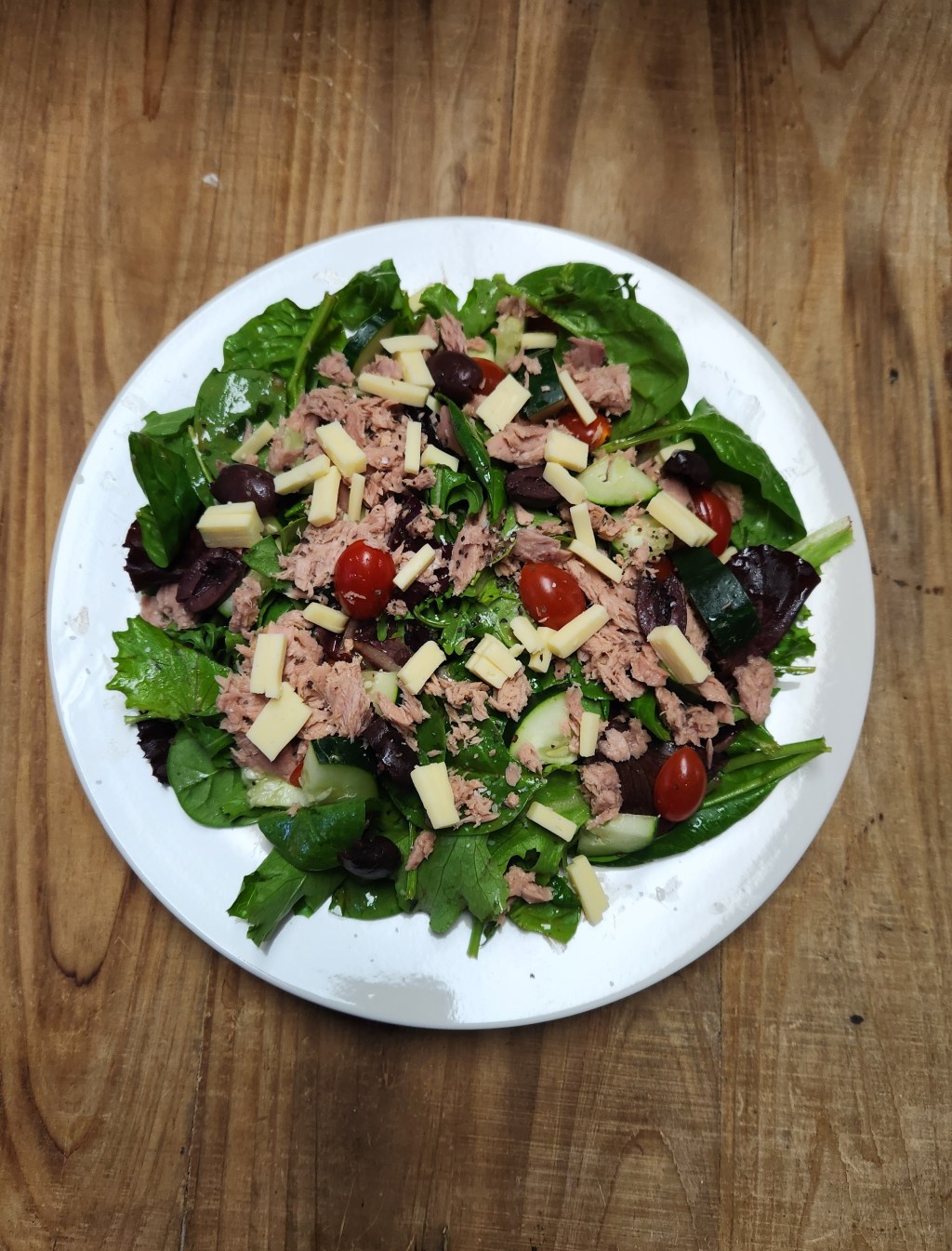
In Castle Rock Kitchen, Carle-Sanders includes a recipe for “Ben’s Really Big Salad.” The recipe includes lots of different options for customization and improvisation. Built around a core of salad greens, salt, pepper, and dressing (the same Nouveau French Dressing recipe that accompanies the crab cakes from “Gramma”), Carle-Sanders provides a range of different suggestions for fruits and vegetables, protein, and garnishes. This makes it easy to tailor based on individual taste or even just what you happen to have in the cupboard or refrigerator at any given moment, an approach that Mama Garraty remarks upon in the recipe’s introduction, noting that “parents and cooks everywhere have long been disguising leftovers as salads” (37). This is exactly what I did with my own version of “Ben’s Really Big Salad,” which included cherry tomatoes, cucumbers, cheese, kalamata olives, and tuna fish. The salad was flavorful and definitely filling, with “really big” in this case being no joke.
But while the salad is delicious and Ben is certainly happier and healthier, it still leaves a metaphorical bad taste in the mouth. As a kid, Ben has brief moments of self-confidence, when he loves himself just the way he is, seeing his size as a strength in standing against the bullies or protecting Bev. There are also a handful of moments when Ben’s weight poses a problem, like when he gets briefly stuck in the window of the House on Neibolt Street, mortified by this limitation and even more so by what Bev must think of him (and how much of him she might see when he comes unstuck). More often, though, Ben simply wishes that he weren’t defined by his weight, that people could see him for the smart, funny, kind young man he is, rather than just the “fat kid.” And while Ben made the choice to lose weight, it’s impossible to remove the abuse that drove him to it from the equation of that decision-making process.
The emotionally fraught nature of Ben’s salads echo some of the previously discussed scenes with Mr. Keene, in the ice cream soda he offers Eddie and the licorice whips he shares with Mike. Ice cream and candy are supposed to be indulgent comfort foods, associated with positive feeling and pleasure, though Mr. Keene uses these treats as a fulcrum for upending Eddie’s whole world and for shrugging off vigilante-style violence as he recounts Derry’s dark history to Mike. Their sugary sweetness cannot be separated from the darker realities that lurk just beneath the surface, both in these individual interactions and in Derry as a whole. Similarly, while Ben’s salads are delicious and help him become the person he wants to be, there will always be the bitter aftertaste of the abuse that motivated him.
Check out Castle Rock Kitchen here: https://outlanderkitchen.com/castle-rock-kitchen
[Page numbers are from 2017 film tie-in edition of IT]

 Exploring Stephen King's Maine