Stephen King’s “N.” (in the 2008 collection Just After Sunset) is a contemporary tale of Lovecraftian horror, as the terror—and its disastrous consequences—pass from one character to the next. Told through a series of letters and psychiatric case notes, Dr. John (Johnny to his friends) Bonsaint records his sessions with N., a patient who tells Johnny of an otherworldly and horrifying encounter he has had in Ackerman’s Field in western Maine, where some monstrous being is attempting to push its way through a thin spot between the two worlds. Johnny feels a jolt of geographic recognition, because Ackerman’s Field is actually quite close to where he himself grew up, not too far from Castle Rock and close to what he remembers from his childhood as the Fail Road Bridge. N. does his best to keep the monster at bay but fails, and when Johnny goes out to set his mind at ease by proving to himself that N.’s story is nothing but a delusion, he becomes the next gatekeeper of the field. This story—along with its processes of skepticism, fear, realization, and death—pass from one person to another, and as the story comes to a close, we’re no nearer to resolution or safety than we were in the beginning.
Castle Rock Kitchen includes several cocktail recipes, one of which is for “Fail Road Eggnog,” inspired by “N.” The power in the field waxes and wanes with the seasons, and while summers are almost unspeakably difficult, the depths of winter and in particular the time around the solstice are comparatively peaceful. During a Christmas visit with his sister Sheila, she tells Johnny that she’s relieved that he seems to be back to his old self. With a twinge of nostalgia, “while we were doing a final polish on the kitchen (and sipping eggnog), I asked her if she remembered why we used to call the Bale Road Bridge the Fail Road Bridge” (232). Sheila laughs and says that one day when they were fishing with their friend Charlie, “Charlie peered over the side and said ‘You know, anyone who fell off this thing could not fail to kill themselves’” (232). “Fail Road Bridge” became a kind of shorthand for the three, bandied about throughout their childhood friendship and a familiar geographic marker for Johnny long after he had moved away … and recognized like an old friend when he returns.
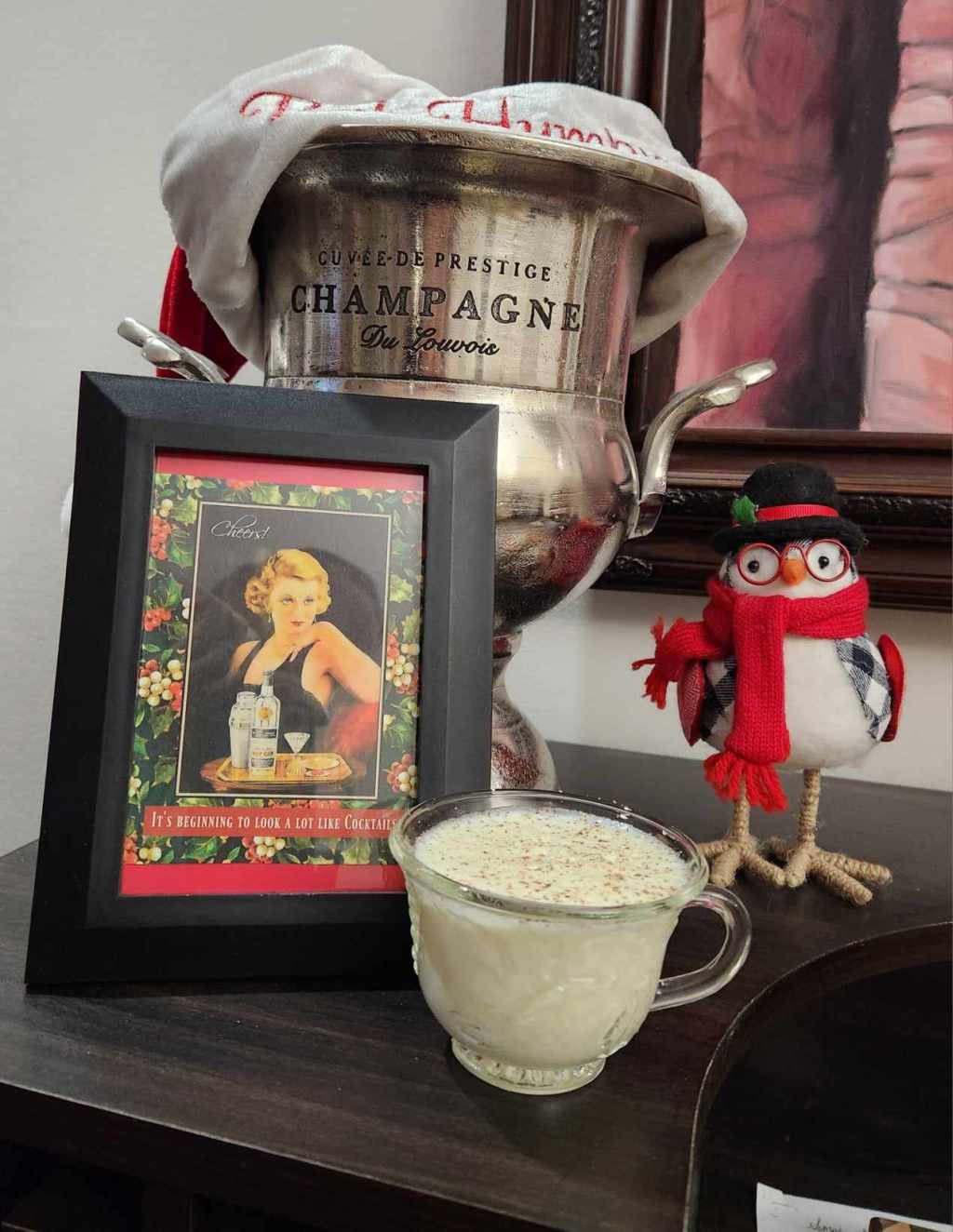
Carle-Sanders’ “Fail Road Eggnog” is serious business. In Mama Garraty’s introduction to the recipe, she notes that this eggnog has “got a shed load of booze in it” (216), a colorful description of measurement that was new to me, but one hundred percent accurate. This eggnog is rich, creamy, and frothy, with the deep, rich flavors of a custard, and the fresh grated nutmeg on top adds just a hint of spice, though the booze itself definitely takes center stage. Making this eggnog is a multistage process, but well worth it, particularly if your previous experiences have been with bland, less flavorful store-bought eggnogs. The flavors are great, though if I make it again, I’ll probably scale back the booze a bit: maybe more of a broom closet load than a shed load.
Overall, drinking this eggnog while thinking about “N.” made me sad. This quiet moment, sipping eggnog with his sister and reminiscing about their childhood on Christmas is pretty much Johnny’s last moment of peace, hope, and rest. Everything gets worse from there and ultimately, Johnny is unable to hold the barrier as it begins to thin once more when spring comes, driving Johnny to his final moments on the Fail Road Bridge.
*** I’ll be taking a break here until the new year, but will be back the week of January 8th, with new posts every Tuesday. See you in 2024—and thanks for coming along as we explore King’s Maine!
Check out Castle Rock Kitchen here: https://outlanderkitchen.com/castle-rock-kitchen
[Page numbers are from the hardcover first edition of Just After Sunset]

 Exploring Stephen King's Maine