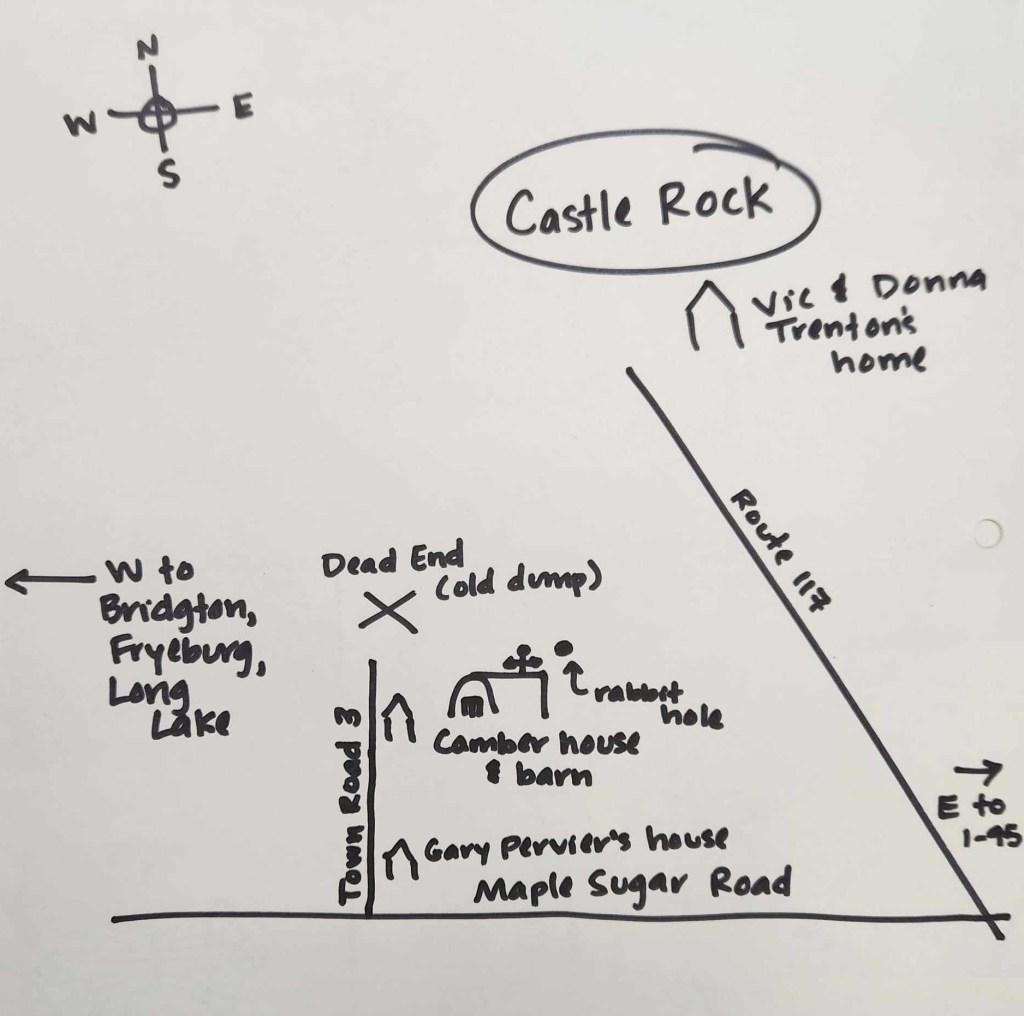
There are lots of different ways to engage with and spatially navigate fictional places, from official maps that accompany the text to fan- and artist-made maps, like those discussed in the “Maps of King’s Maine” post. Another level of engagement at the fan or creator level is for the reader to craft their own map of the text as a way of imaginatively interacting with that space, an activity I have used in my own classes over the years, most recently with my Stephen King class’s reading of ‘Salem’s Lot (1975). Drawing a map like this requires attention to spatial details and close reading focused on setting and place, information that often fades into the background for the reader as they attend more closely to what’s going on with the characters and their conflicts.
This is certainly the case in Cujo (1981). The few descriptions of the route from Castle Rock to the Cambers’ place come at pretty high tension moments, in some cases for both the characters and the reader. The most detailed accounting of this route comes when Donna and Tad are heading out there in the hopes that Joe Camber will be able to fix the finicky Pinto, and between the car acting up and Donna’s stress about whether or not they’ll get there and what she’ll do if they don’t (not to mention all the emotional fallout of the recently exploded Steve Kemp affair), road names and turnings seem to be the least of her (and our) problems.
But King does provide detailed descriptions of Donna and Tad’s drive, starting with their heading “southeast along Route 117 toward the Maple Sugar Road, which was about five miles out of town” (143). Each mile takes them further from civilization as woods crowd toward the edges of the highway and when they turn off the well-traveled highway onto Maple Sugar Road, the road sign is “faded … [and] splintered considerably by kids banging away with .22s and birdshot” (144). The smooth asphalt gives way to a “bumpy and frost-heaved” blacktop and the nice houses give way to trailers and squalor, including a toddler with a falling down diaper picking his nose as he blankly watches them drive by (144). Their final turn is on to Town Road No. 3, where Gary Pervier and the Cambers live and from here, there’s really no way out and no traffic to hope for: there used to be a town dump at the end of the road but now that it’s closed, Town Road No. 3 is just a dead end, with nothing and no one beyond the Cambers’ driveway.
The route to the Cambers’ place comes up another couple of times in Cujo: once when the mailman George Mears comes down Town Road No. 3 (but Joe has requested the mail be held for a few days, so no salvation for Donna and Tad comes from that direction) and again in the novel’s final pages, when Vic Trenton decides to head out to the Cambers’ place quick to have a look (though his arrival comes too late). In both of these cases, the reader is likely caught up in the suspense of the narrative moment and the potential for rescue, desperate to see what will happen rather than paying close attention to navigational directions, which for the most part remain in the characters’ background thoughts or peripheral awareness as well.
With an eye toward these details, I sketched my own map of Cujo, focusing on Donna and Tad’s route from their home to their fatal encounter with Cujo in the Cambers’ dooryard. It was an interesting and instructive experience and, as previously discussed, I found myself paying closer attention to these navigational details and more aware of the specifics of space than in previous readings of the novel. I’m definitely not an artist, but I was able to sketch out the basics, anyway.
As I reflected on these details and considered the map, however, I came to the conclusion that this mapping was really pretty inconsequential. It’s interesting to know where Donna and Tad made the turns that took them closer to their nightmare and this landscape is definitely clearer in my mind now than it was before. But this route and these roads are not the space that really matters. As Donna and Tad face Cujo, the only space that really matters is in the confines of their Pinto: the sweltering heat, the windows they don’t dare to roll down beyond the merest crack, the lack of room that results in uncomfortable dozing and stiff limbs. Everything beyond that becomes theoretical. Donna could make the run to the Cambers’ kitchen door and hope to get inside, but practically speaking, that door might as well be miles away. Castle Rock might as well be in another time zone or even on another planet. There is a world outside the Pinto, with roads that could take them away from this horror, but Donna and Tad can’t get there from here.

 Exploring Stephen King's Maine