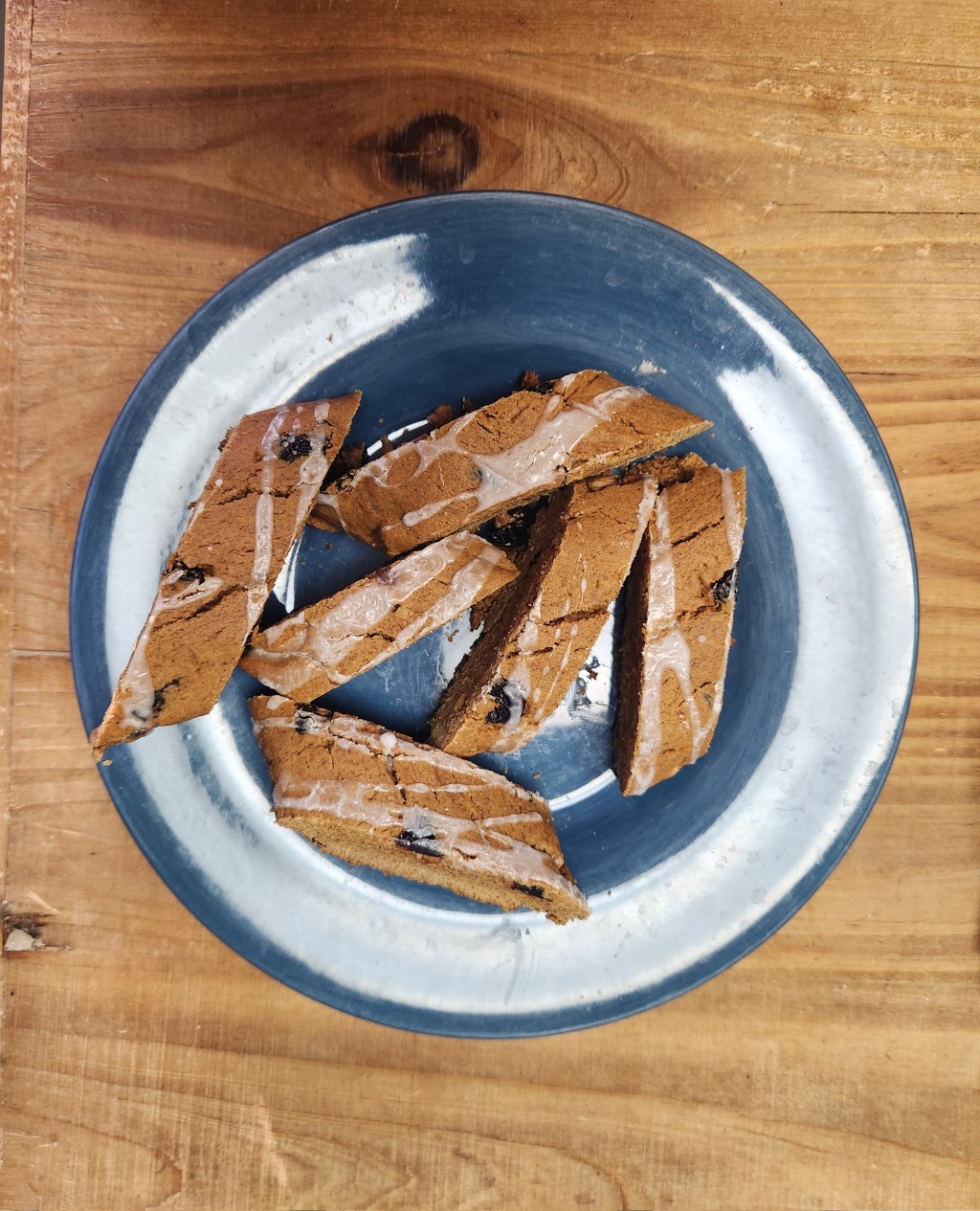
Theresa Carle-Sanders’ choice of Ray Garraty’s mother from The Long Walk as a narrator for Castle Rock Kitchen is a fascinating one. The woman has no name and remains peripheral to the action, hovering in the shadows even when present. She appears physically only twice in the novella, first in the opening pages when she drops Ray off at the starting line of the Long Walk and later, alongside Ray’s girlfriend Jan as the Walkers make their way through Freeport, Maine. However, even when she is right in front of him, Ray’s mind is elsewhere, wrapped up in his nerves about the start of the Walk, his relief at seeing Jan, and the sheer act of survival. While the woman herself appears infrequently in The Long Walk, however, her presence resonates throughout the novella, in Ray’s memories as he walks and even more impactfully, in the cookies she sends with him to provide sustenance, give him a taste of home, and remind him that he is loved.
Mama Garraty’s narrative voice throughout Castle Rock Kitchen is similarly pervasive and grounding: she knows the history of King’s Maine and its inhabitants well, she is well-versed in Maine’s foodways and traditions, and her approach to cooking and sharing this knowledge is pragmatic and practical. She is a woman who knows how to care for those she loves and what it takes to survive. Given her central position in the cookbook, The Long Walk is a perfect place to start our cooking Castle Rock Kitchen adventure.
In the dystopian world of the Long Walk, each year one hundred young men participate in this barbaric competition, setting off on a walk in which only one of them will survive, with the winner able to name his own prize. Under the dictatorial eye of the Major and his soldiers, the boys walk nonstop—day and night, rain and shine—and must keep a minimum pace of four miles per hour, getting warnings when their pace slows or their endurance falters. While warnings can be gained and shed as the boys walk, once a Walker has accumulated three warnings, he is executed, done walking for good. Spectators crowd the roadsides and news coverage is fanatical, with everyone clamoring to witness the spectacle of the Long Walk and the death that marks so many of its miles.
Food frequently carries tremendous significance in dystopian fiction, where the stark division between the haves and the have nots often includes who has access to what kind of food and who goes hungry, distinctions which reveal and reflect the power dynamics and hierarchies that shape their worlds. In keeping the Long Walk going for as long and as competitively as possible, the young men’s bodies must be fed, which the soldiers ensure through the distribution of high-calorie food belts each morning, sustenance reduced to concentrates. In the late afternoon of his first day of walking, “Garraty had supper—a tube of processed tuna fish, a few Snappy crackers with cheese spread, and a lot of water. He had to force himself to stop there … there would be no fresh concentrates until tomorrow morning at nine o’clock … and he might want a midnight snack. Hell, he might need a midnight snack” (168, emphasis original). The food the Walkers are provided with is pared down to its most essential form and in eating it, the Walkers have to think explicitly of survival, of the concentrates as a finite source of fuel for their bodies, rather than being dictated by hunger, taste, or preference.
In the comparison of haves and have nots, as the boys down their concentrates and keep putting one foot in front of the other, the crowds who come watch and cheer are well-supplied with hot dogs and fair foods, chomp sandwiches, or spread picnic lunches as they watch the boys pass by. As the Walkers near an overpass late the first day, “several people cheered them around mouthfuls of Dunkin’ Donuts from the glass-walled shop situated near the base of the exit ramp” (175). All of these people are safe, sitting, and stuffing their faces with whatever whets their appetite, not needing to worry about making it last or the role this food plays in their body’s endurance and survival, though they seem callously unaware—or perhaps simply unmoved by—how this dissonance may impact the Walkers who pass by them. Like popcorn at the movies, the watchers mindlessly munch away, spectators to the life-and-death struggle proceeding down the road before them. When Ray gets angry at the sight of all the people waving and cheering and eating as the boys walk themselves to death, McVries reminds him that “Death is great for the appetites … They like it better, they feel it and taste it better because they’re watching dead men” (222). The spectators will go on living and this proximity to death makes them relish the mundane details of their everyday existence all the more, while the Walkers themselves are confronted by what they have already lost, their inevitable end and the suffering that will take them there.
While assisting the Walkers in any way is expressly forbidden, one enthusiastic man, Dom L’Antio, has a trunk full of chilled watermelon and throws pieces to the Walkers. This act of joyful resistance provides the boys with a brief reprieve, both from their hunger and from their loss of faith in humanity, as they toss the contraband watermelon chunks between themselves. As Ray digs into his piece of watermelon, “some of the juice got up his nose, some more ran down his chin, and oh sweet heaven in his throat, running down his throat” (246). This small gift of food, a hard-fought-for bite, temporarily replenishes Ray, as he “felt a crazy joy breaking through him, pumping his heart” (246). The Long Walk isn’t any less fatalistic, but the sweetness of the melon and the kindness of this man offer temporary relief.
While the concentrates are their main source of sustenance, many of the Long Walkers also bring some food of their own, something small—they have to carry it, after all—and often largely symbolic, something that might lend them an edge or some comfort, a small taste of the home they are leaving behind, nearly all of them for good. Stebbins brings three jelly sandwiches that he works his way through over the course of the Walk’s first day, while McVries nibbles away at a hunk of raw hamburger for its “good fast energy” (156).
Ray has a foil-wrapped package of his mother’s homemade cookies. She gives them to him as she prepares to say goodbye at the starting line, saying “I made these. You can take them, can’t you? They’re not too heavy, are they?” (142). As the Walk gets underway, Ray thinks again “of the cookies his own mother had given him—pressed on him, as if warding off evil spirits” (148). There’s nothing she can do to protect him and she is a woman of few words, not prone to mushy displays of love or affection, but she can give him these cookies.
Carle-Sanders’ Castle Rock Kitchen version of these cookies are her “Hermits for the Road,” a dense cookie packed with warm spices, walnuts, and raisins. In Mama Garraty’s introduction to the recipe, she notes that “I scrounged every pantry in the neighborhood for a few of the walnuts he liked so much” (187), a reflection both restricted access to food and neighborly support. This also reflects the personalized touch of sending Ray off with something he enjoys, though she knows that it will offer little protection against the nightmares that await him on the road. Carle-Sanders’ hermits are ideally suited for the Long Walk: the combination of spices are reminiscent of gingerbread, comforting and homey. With the thought and work Mama Garraty has put into these cookies, every bite is infused with Ray’s mother’s love, while the raisins and nuts will provide a more practical boost of energy. The dense, firm texture ensures that these cookies won’t crumble to bits, shoved into a pocket and relentlessly jostled for mile after mile. Carle-Sanders notes that the hermits keep for up to two weeks in an airtight container, which is longer than any of the Long Walkers will endure, though this does mean that if Ray saves one his mother’s cookies for his final stretch, it won’t let him down.
Whatever the outcome of the Long Walk, Ray will never really be able to go home again, but with his mother’s cookies, he has brought a small taste of home along with him, a fond memory and a tangible, practical token of his mother’s love.
Check out ‘Castle Rock Kitchen’ here: https://outlanderkitchen.com/castle-rock-kitchen
[Page numbers are from 1985 Plume Edition of The Bachman Books]

 Exploring Stephen King's Maine